


India’s electric vehicle market could grow into a Rs 20 lakh crore industry by 2030 and generate around five crore jobs, Union Road Transport and Highways Minister Nitin Gadkari said on Wednesday.
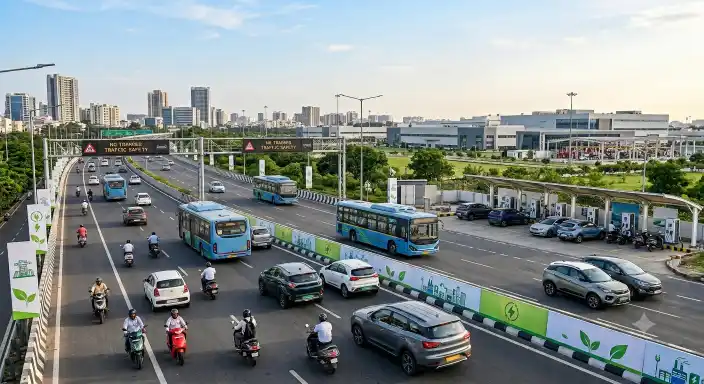
Speaking at a summit organised by the CII-ITC Centre of Excellence for Sustainable Development, Gadkari said India currently has around 57 lakh registered electric vehicles, with EVs accounting for about 7% of the overall automobile market.
He said the rapid expansion of electric mobility could create significant opportunities for manufacturing, employment and exports as India works towards becoming a global automobile leader.
Gadkari also pointed to the export performance of major Indian two-wheeler manufacturers Bajaj Auto and Hero MotoCorp, noting that both companies export more than half of the vehicles they manufacture.
India Needs More Electric Buses
Gadkari said India currently has annual demand for around one lakh electric buses, while domestic manufacturers are producing only about 50,000 to 60,000 EV buses each year.
He said increasing electric bus production would be important to meet rising demand and support the country’s transition towards cleaner transportation.
The minister also set an ambitious target of making India’s automobile industry the world’s largest within the next five years. He said India has the skilled workforce and competitive manufacturing capabilities needed to achieve the goal, although it would be challenging.
According to Gadkari, India’s automobile industry has expanded significantly in recent years. He said its value was around Rs 14 lakh crore when he took charge as transport minister, compared with roughly Rs 22 lakh crore currently.
He put the value of the US automobile industry at around Rs 78 lakh crore, China’s at Rs 47 lakh crore and India’s at approximately Rs 23 lakh crore.
Focus on Reducing Fossil Fuel Imports
Gadkari also stressed the need to reduce India’s dependence on imported fossil fuels. He said the country spends around Rs 22 lakh crore on fossil fuel imports, which also contributes to pollution.
The minister highlighted highways, alternative fuels and biofuels as important parts of India’s future transportation strategy.
Government Targets Lower Logistics Costs
Reducing logistics costs is another major priority, Gadkari said. The government aims to bring India’s logistics costs down to around 8% to make Indian businesses more competitive in global markets.
Gadkari cited a recent study by IIT Chennai, IIT Kanpur and IIM Bangalore, which found that the development of expressways and economic corridors has helped bring logistics costs down from around 16% to 10%.
The government now aims to reduce the figure further to 8%, supporting India’s manufacturing, exports, electric mobility and broader economic growth.
