


The Central Board of Secondary Education (CBSE) has relaxed the implementation of its upcoming three-language policy by allowing students currently studying in Classes VII, VIII and IX with two foreign languages to continue the same language combination while adding one Indian language.
The board clarified that students appearing for the Class X Board examinations under the current academic structure will continue with the existing two-language system and will not be affected by the revised framework.
New Policy to Begin From 2026-27
The revised language policy, aligned with the National Education Policy (NEP) 2020, will come into effect from the 2026-27 academic session. The changes are aimed at ensuring a smoother transition after schools and parents expressed concerns over the implementation of the new language structure.
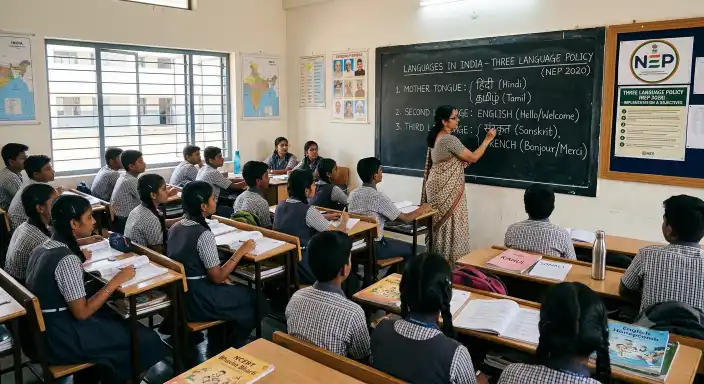
Under the revised framework, students entering Class IX in 2026-27 will study three languages, with at least two being Indian languages such as Hindi, Tamil, Bengali, Marathi or other Bharatiya Bhashas. The third language can either be another Indian language or a foreign language like English, French or German, depending on the student’s existing language choices.
One-Time Relaxation for Transition Batches
As a special transitional measure, students who are already pursuing two foreign languages will be allowed to continue with that combination by adding one Indian language. For these batches, the additional language will be assessed internally by schools, eliminating the need to appear for a Class X Board examination in the third language.
The same exemption will also extend to students currently enrolled in Classes VII and VIII when they move to the secondary level.
Full Rollout for Current Class VI Students
The three-language policy will be fully implemented for students who are currently in Class VI and all future batches. These students will study three languages, including two Indian languages, and will eventually take a Board examination in the third language during the secondary stage.
To facilitate the rollout, CBSE and NCERT are preparing teaching and learning resources in all 22 scheduled Indian languages.
Special Exemptions and Flexibility
The board has also announced exemptions for Children with Special Needs covered under the Rights of Persons with Disabilities (RPwD) Act, CBSE-affiliated schools located outside India, and foreign students returning to the country. In addition, children from migrant families will be given flexibility in selecting language combinations.
Maharashtra Makes Marathi Mandatory
Separately, the Maharashtra government has made Marathi a compulsory subject from Classes 1 to 10 across all educational boards operating in the state. Schools failing to comply with the directive could face strict action, including cancellation of their permission and registration.
