


India is reviewing whether to limit how many airport projects a single company can win in its upcoming privatisation drive covering 11 airports. The move comes amid rising concern that too much concentration in one operator’s hands could distort competition in civil aviation and create systemic risks.
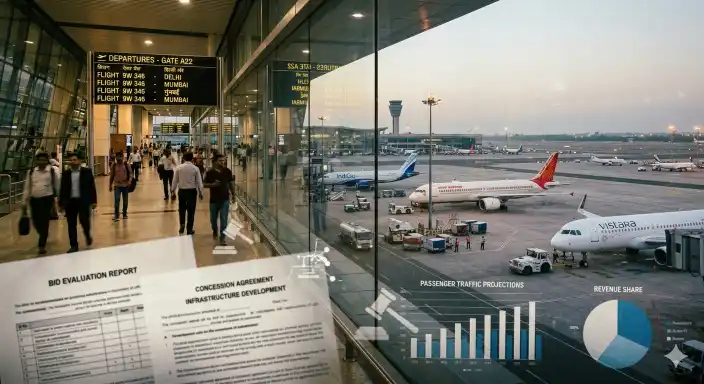
Officials involved in the process say the government is actively discussing how to design bidding rules that keep the market competitive while still attracting strong private investment.
Market concentration fears shape the debate
The trigger for the discussion has been growing unease about dominance in airport operations and how it could affect resilience in the aviation ecosystem. The issue gained urgency after operational disruptions linked to IndiGo last year, which exposed how shocks in one large network can ripple across the sector.
A senior official noted that airports behave like natural monopolies in their regions. That makes it risky, in their view, if too many critical hubs end up controlled by a single player.
Lessons from the 2018 privatisation round
The last major airport privatisation exercise in 2018 had no restrictions on how many projects a bidder could win. In that round, Adani Enterprises secured all six airports on offer, in some cases outbidding competitors by a wide margin.
That outcome is now shaping today’s policy thinking, especially since the same group has indicated interest in aggressively bidding for all 11 airports in the upcoming round.
Proposed cap and bidding structure
One of the proposals under discussion would limit a single bidder to winning a maximum of two airport “bundles,” which could translate into four airports in total.
Another safeguard being examined is a fallback mechanism: if the same bidder wins a third bundle, the second-highest bidder could be allowed to match the winning price to stay in contention.
The idea is to balance competition with revenue protection, without allowing excessive concentration.
Bundling strategy to balance strong and weak airports
For the first time, the government is also planning to bundle airports strategically. Seven smaller airports will be grouped with six larger ones located in similar regions to make the packages more attractive to investors.
For example, Varanasi is expected to be paired with Kushinagar and Gaya. Similarly, cities like Amritsar, Bhubaneswar, Raipur, and Tiruchirappalli will be bundled with smaller airports such as Kangra, Tirupati, Aurangabad, and Hubli.
This structure is designed to ensure that less profitable airports also get private investment for development.
Why policymakers are cautious
Officials argue that over-consolidation in airport ownership could create vulnerabilities for the entire aviation network. Since airports are essential infrastructure, disruption at a large operator level can have widespread consequences.
They point to recent industry stress events, including operational challenges faced by IndiGo, as a reminder of how interconnected the system has become.
Revenue vs regulation: the internal debate
Not everyone within the government agrees on restricting bids. Some finance ministry officials worry that caps could make bidders more cautious, which might reduce overall revenue from the auctions.
They argue that the 2018 round generated strong financial gains for the state-run Airports Authority of India, which continues to earn over ₹700 crore annually from the airports it leased out.
This camp believes too much restriction could dilute competition and lower auction premiums.
Institutional framework and decision-making
The process is being shaped jointly by the civil aviation ministry, the finance ministry, and NITI Aayog. The final approval will rest with the Public Private Partnership Appraisal Committee, which oversees major infrastructure privatisation decisions.
A high-stakes monetisation push
The broader push fits into the government’s larger asset monetisation strategy, which targets ₹27,500 crore from the civil aviation sector under the National Monetisation Pipeline (NMP 2.0) through FY30.
As the policy takes shape, the central question remains simple: how to open the sector to competition without letting it consolidate into too few hands.
