


Prime Minister Narendra Modi has set an ambitious target for India to achieve 100 GW of nuclear energy capacity by 2047, placing energy security and self-reliance at the centre of his Independence Day address.
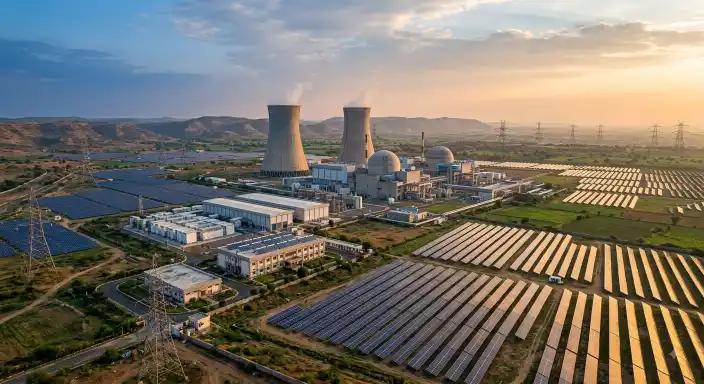
Speaking from the Red Fort on India’s 80th Independence Day, Modi said India was moving ahead with plans to commission five new nuclear reactors and strengthen its domestic nuclear fuel capabilities.
India Pushes Nuclear Energy
Modi highlighted India’s progress in fast breeder nuclear technology, calling it an important step towards reducing the country’s dependence on imported fuel.
He said India had achieved a major breakthrough in Fast Breeder Nuclear Technology this year, strengthening the country’s efforts to become more self-reliant in nuclear energy.
The Prime Minister said a nation’s progress could be held back not only by a lack of resources but also by limited thinking. He stressed the need for India to make better use of its own capabilities and reduce its dependence on imported crude oil.
Growth in Piped Gas and Solar Power
Modi also highlighted the expansion of India’s energy infrastructure over the past decade.
He said piped gas coverage had expanded from around 70 cities before 2014 to nearly 700 cities. The number of households receiving piped gas has also increased from around 20 to 22 lakh to nearly 1.75 crore.
India’s solar energy capacity has seen a major rise as well. According to Modi, solar capacity increased from around 2 GW in 2014 to 160 GW.
He also pointed to the PM Surya Ghar Muft Bijli Yojana, under which more than 50 lakh households have adopted rooftop solar systems.
Focus on Self Reliance
Modi placed Atmavishwas, Atmagaurav and Atmanirbhar Bharat at the heart of his Independence Day message. He said self-confidence, self-respect and self-reliance were important for India’s progress towards becoming a developed nation by 2047.
He urged citizens to support Make in India, Swadeshi and Vocal for Local and called for Indian products to reach more international markets.
The Prime Minister said Indian companies must meet global standards and offer products that are both high in quality and competitive in price.
India Expands Semiconductor Manufacturing
Semiconductor production was another key area highlighted by Modi.
He said production had already begun at three semiconductor plants in India, while another five to eight plants are expected to come up over the next seven to eight years.
The government has been supporting semiconductor manufacturing, assembly, testing and packaging through the India Semiconductor Mission as part of efforts to build a stronger domestic chip industry.
Defence Production and Technology Growth
Modi also pointed to India’s progress in defence manufacturing and technology.
He said defence production had increased fourfold over the past 12 years. The Prime Minister also highlighted a fourfold rise in patents granted and a fourfold increase in the number of internet users.
He said these developments reflected India’s growing technological and manufacturing capabilities.
India’s Energy Security During West Asia Crisis
The Prime Minister said the West Asia crisis had raised concerns about possible shortages of petrol, diesel, LPG and other essential supplies in India.
However, he said government measures had ensured that the country continued to have adequate supplies of gas, fuel and urea.
Modi said India’s growing self-reliance had helped the country withstand external pressures during a period of global uncertainty.
India’s Growing Global Presence
Modi said the world was increasingly recognising India’s economic strength and capabilities. He pointed to free trade agreements with around 40 countries as an indication of India’s expanding global economic presence.
He also said India had moved out of the group once described as the Fragile Five, referring to emerging economies considered vulnerable to external financial pressures.
Poverty Reduction and Viksit Bharat
The Prime Minister said the determination of poor citizens had helped 24 crore people move out of poverty.
The figure is broadly in line with a NITI Aayog estimate that 24.82 crore people moved out of multidimensional poverty between 2013-14 and 2022-23.
Modi reiterated his goal of building a Viksit Bharat by 2047 and called on citizens to set bigger goals and strengthen the country’s capabilities.
13th Independence Day Address
Saturday’s speech marked Modi’s 13th consecutive Independence Day address from the Red Fort.
He began the occasion by paying tribute to freedom fighters and remembering their sacrifices in ending colonial rule. He said their vision continued to inspire India’s journey towards a developed nation.
The Independence Day celebrations also marked 150 years of Vande Mataram. For the first time, the National Song was rendered as part of the Independence Day celebrations, adding a special element to the ceremony.
The Prime Minister’s address focused broadly on energy security, self-reliance, manufacturing, technology, defence, poverty reduction and India’s ambition to become a developed nation by 2047.
