


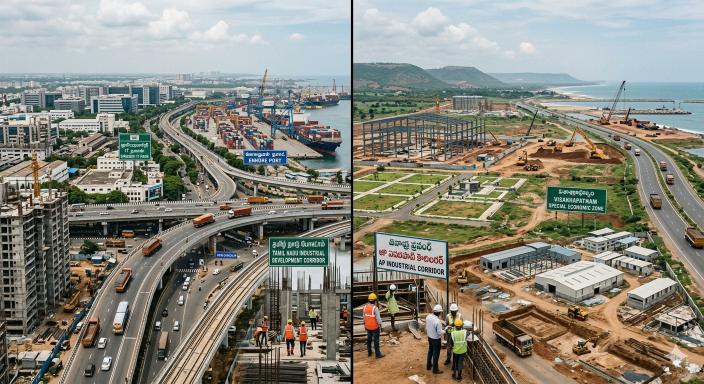
Tamil Nadu and Andhra Pradesh are neighbouring states, but their economic paths look very different. Tamil Nadu is a mature industrial economy with strong manufacturing depth, while Andhra Pradesh is moving fast as a new investment hotspot driven by infrastructure and Amaravati’s revival. The real comparison today is not size alone, but long-term readiness for future growth.
Economic strength and scale
Andhra Pradesh is building growth through infrastructure and large projects. Its GSDP for 2024–25 is around ₹16 lakh crore, supported by Amaravati development, ports, industrial corridors, renewable energy and manufacturing push in electronics, defence and logistics. Tamil Nadu stands much larger at about ₹32 lakh crore, nearly double Andhra Pradesh. It has a diversified base across automobiles, electronics, textiles, engineering and services, with a long-term target of becoming a $1 trillion economy by 2030.
Manufacturing and industrial base
Tamil Nadu has a long-established industrial ecosystem built over decades. Manufacturing contributes around 22–24% of its GSDP and it accounts for nearly 15% of India’s total manufacturing output, with exports crossing $45 billion annually. It leads in automobiles, electronics exports, textiles and garments. Andhra Pradesh is expanding quickly in new investments, with about ₹1.89 lakh crore proposed in FY26. Its manufacturing share is still developing at around 11–13% of GSDP, with industrial hubs like Sri City, Visakhapatnam, Krishnapatnam, Orvakal and Amaravati focusing on electronics, defence, renewable energy and logistics.
Real estate and investment sentiment
Andhra Pradesh’s real estate growth is strongly linked to Amaravati’s revival, where land prices have risen 30–60% in select areas. Prime land rates in the capital region range between ₹25,000 and ₹60,000 per sq. yard, with major development planned across Amaravati, Mangalagiri, Tadepalli, Vijayawada and Guntur. Tamil Nadu’s property market is more stable and demand-driven, especially in Chennai and its suburbs, where prices have grown 10–20% in areas like OMR, Sholinganallur and Perumbakkam. Prime residential rates in Chennai generally range from ₹7,000 to ₹20,000+ per sq. ft, supported by steady IT and industrial demand.
Infrastructure development
Andhra Pradesh is building new infrastructure around Amaravati with investments of about ₹64,000 crore. It has key ports like Visakhapatnam, Krishnapatnam and Gangavaram, handling a significant share of India’s cargo. The state has six operational airports and is part of major industrial corridors like VCIC and CBIC. Tamil Nadu, meanwhile, has a mature infrastructure base with over 7,000 km of highways, four international airports and major ports including Chennai, Kamarajar and VOC Port. Chennai Metro Phase 2 alone is a ₹63,000 crore project adding nearly 119 km, and the state is part of multiple industrial corridors including Chennai–Bengaluru, Chennai–Kanyakumari and Madurai–Thoothukudi.
Jobs and talent pool
Andhra Pradesh has a population of about 5.4 crore with a literacy rate of 67.4%. Growth in manufacturing, logistics and renewable energy is expected to generate large-scale employment in cities like Visakhapatnam, Vijayawada, Tirupati and Amaravati. Tamil Nadu has a larger population of around 8.2 crore and a literacy rate of 82.9%, among the highest in India. It has over 35 lakh manufacturing workers and a strong technical ecosystem supported by more than 2,000 engineering colleges, with major job hubs in Chennai, Coimbatore, Tiruppur, Hosur and Madurai.
Investment destination comparison
Andhra Pradesh has attracted about ₹1.89 lakh crore in proposed FY26 investments, driven by renewable energy, electronics, logistics, defence and industrial parks. Its large land availability supports greenfield projects and new industrial clusters. Tamil Nadu remains one of India’s most trusted investment destinations with over ₹10 lakh crore in commitments in recent years and about $17 billion in FDI between FY20 and FY25. It continues to host major global companies in automobiles, electronics, aerospace and manufacturing.
Tamil Nadu leads with scale, stability and a deeply rooted industrial ecosystem that supports exports and large-scale manufacturing. Andhra Pradesh is growing faster in new investments and infrastructure-led development, making it one of India’s emerging industrial hubs. One state reflects long-term maturity, while the other reflects rapid expansion.
