


Hyderabad-based spacetech startup Cosmoserve Space has inaugurated Base 1, India’s first private facility dedicated to developing technologies for space debris removal and satellite servicing. The facility is also described as the world’s sixth of its kind.
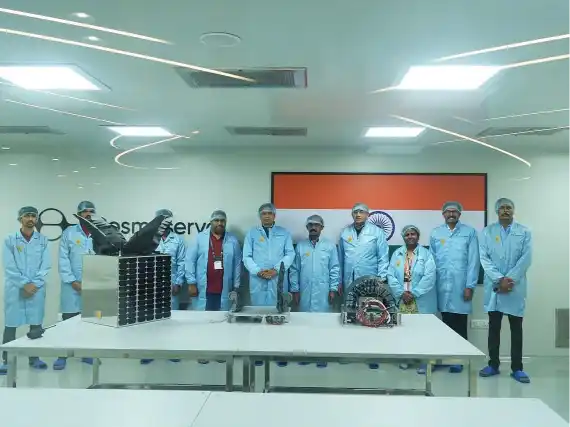
Located at VSD Tech Park in Gachibowli, Base 1 brings together infrastructure for designing, building and testing robotic systems that can capture inactive satellites, remove debris from orbit and support in-orbit repairs and refuelling.
The facility was inaugurated on November 5 by Union Minister of State for Science and Technology Jitendra Singh, who joined virtually, and Telangana IT and Industries Minister D Sridhar Babu.
Spread across approximately 14,800 square feet, Base 1 houses four specialised facilities: an Orbital Rendezvous and Capture Lab, a Space Robotics Innovation Lab, an ISO Class 8 satellite integration clean room, and a Mission Simulation and Control Centre.
Cosmoserve Raises $6 Million
Alongside the facility launch, Cosmoserve announced a $6 million seed funding round, taking its total funding to more than $9 million. Japan-based Rebright Partners joined Indian investors Aranya Holdings, Naandi Ventures, AUM Ventures and Shakti VC in the round.
The funding will support the facility, technology development and upcoming demonstration missions. The company plans to conduct its next technology demonstration by mid-2027 and aims to begin commercial operations in early 2028.
Founded by Chiranjeevi Phanindra, Cosmoserve is developing a dual-spacecraft architecture to service multiple satellites. A larger Orbital Service Station will act as an in-space logistics hub carrying fuel, equipment and spare parts. Smaller Autonomous Service Vehicles will travel to individual satellites to capture, inspect, repair or remove them from orbit.
The company says this approach could allow two spacecraft to service up to 100 satellites and potentially reduce servicing costs from around $10 million to below $1 million per satellite.
Addressing the Growing Space Debris Challenge
The increasing number of inactive satellites and fragments in Earth’s orbit poses risks to operational spacecraft and future space missions. Cosmoserve estimates that nearly 10,000 of the approximately 28,000 satellites in orbit are dead or non-operational.
The company is initially focusing on debris larger than 10 cm and weighing up to 500 kg. Its technology roadmap includes robotic capture systems, microgravity testing and a full-scale debris capture demonstration in 2027.
Cosmoserve conducted its first in-space technology demonstration, Mission Embrace, aboard Skyroot Aerospace’s Vikram-1 rocket in July 2026. It is also working with partners including Pixxel for satellite systems and Skyroot Aerospace for launch services.
The facility supports India’s wider ambition to develop indigenous space sustainability technologies. Jitendra Singh has outlined a vision of achieving debris-free space by 2030, as India’s private space sector expands its role in satellite operations and orbital infrastructure.
