


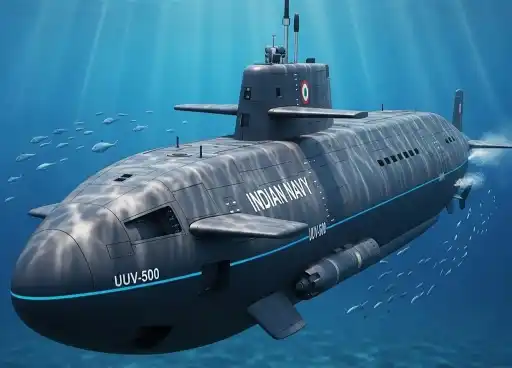
Larsen & Toubro (L&T) is planning to expand its autonomous underwater vehicle (AUV) portfolio with the development of an Extra Large Uncrewed Undersea Vehicle (XLUUV), according to a report by IDRW. The proposed platform is intended for long-duration underwater operations and could add new capabilities to India’s maritime defence ecosystem.
The vehicle is being designed for open-ocean transit, seabed missions and autonomous navigation. It could undertake intelligence, surveillance and reconnaissance (ISR), maintain a persistent underwater presence and support expeditionary operations.
Focus on Indigenous Technology and Systems
L&T has reportedly begun work on several technology areas for the proposed platform, including software, sensors, radar and radome systems, towed arrays, satellite communications, batteries, propulsion, power distribution and hydrodynamics.
The company is also in discussions with private-sector firms in India for the supply of systems and subsystems. This could create opportunities for domestic defence manufacturers and technology suppliers to participate in the programme.
A modular payload section is being considered to allow the vehicle to be reconfigured for different missions. Sensors, communication equipment and other mission-specific modules could be integrated depending on operational requirements.
Hybrid Propulsion Under Consideration
The proposed XLUUV may use a hybrid propulsion system combining battery technology with marine diesel generators. This could support extended operations while allowing battery-powered movement during intelligence-gathering missions where reduced detectability is important.
However, L&T has not disclosed the vehicle’s dimensions, submerged displacement, payload capacity, range or endurance. These specifications remain unconfirmed as the programme is still at the pre-concept stage.


L&T’s Growing Underwater Defence Portfolio
L&T already has experience in autonomous underwater systems and submarine engineering. Its existing AUV portfolio includes Amogh, Adamya and Maya. The company is also involved in the Indian Navy’s submarine development ecosystem, including work related to the Project-76 conventional submarine programme and its SOV-400 midget submarine concept.
The proposed XLUUV would represent another step in the company’s expansion into advanced underwater platforms. Its eventual design and development could be shaped by the Indian Navy’s operational requirements in the coming years.
The development is an industry-led proposal at an early stage and should not be confused with a confirmed Indian Navy procurement order or an approved platform specification.
