


Thiruvananthapuram-based spacetech startup HEX20 has developed critical spacecraft systems for the United Arab Emirates’ Emirates Mission to the Asteroid Belt (EMA). The company’s spacecraft bus, onboard systems and autonomous software were presented to Dubai Crown Prince and UAE Deputy Prime Minister Sheikh Hamdan bin Mohammed bin Rashid Al Maktoum, highlighting Kerala’s growing contribution to advanced space technology.
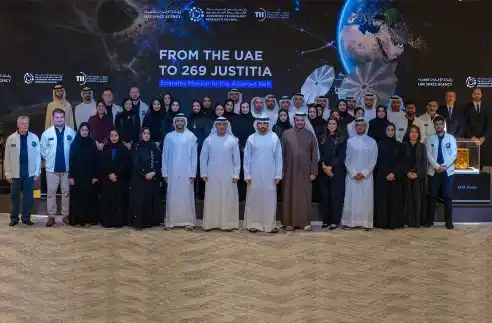
The UAE Space Agency selected HEX20 to develop the asteroid exploration spacecraft following a design workshop organised in November 2024 by the UAE Space Agency and the Technology Innovation Institute (TII). The startup said it developed the spacecraft’s key systems in approximately 15 months.
Spacecraft Bus and Autonomous Systems
The spacecraft bus forms the structural and operational foundation of a spacecraft. It houses essential systems that provide power, computing, control and other functions required for the mission.
HEX20 developed an onboard computer and power system designed to withstand the demanding conditions of space. One of its key contributions is the spacecraft’s autonomous operating capability, which allows onboard programmes to run without continuous direct commands from Earth.
Although the spacecraft will maintain communication with the MBR Explorer mission control centre, its software will enable it to perform designated operations independently. Such capabilities are important for deep-space missions, where communication delays can make continuous ground-based control difficult.
UAE’s Ambitious Asteroid Exploration Mission
The MBR Explorer is scheduled for launch in March 2028. Over an eight-year journey, the spacecraft is expected to travel approximately five billion kilometres to explore the main asteroid belt.
The mission will use gravitational assistance from Venus, Earth and Mars to reach the asteroid belt. It is planned to fly past six asteroids before reaching its final target, 269 Justitia. A separate probe will then detach from the MBR Explorer and operate independently as part of the exploration programme.
Scientists hope that studying 269 Justitia will provide insights into the early solar system, including how water, organic materials and other volatile substances were distributed during its formation.
International Collaboration Behind the Mission
The spacecraft’s assembly was completed in Abu Dhabi through collaboration among the UAE Space Agency, TII’s Propulsion and Space Research Centre, Khalifa University, the National Space Science and Technology Center at UAE University, and HEX20.
The spacecraft is planned to be transported to Colorado in the United States for integration with the MBR Explorer.
HEX20’s Global Spacetech Presence
HEX20 operates an engineering division at Technopark in Thiruvananthapuram and a UAE operations centre in Masdar City, Abu Dhabi. The company also has a presence in the United States and Taiwan.
Its offerings include satellite platforms, Satellite Mission-as-a-Service and payload hosting for in-orbit experiments. HEX20 has also highlighted its role in developing a ride-share satellite in India’s private space sector.
According to CEO Amal Chandran, the achievement demonstrates the company’s ability to develop systems for technically demanding space missions.
HEX20’s participation in the UAE’s interplanetary exploration programme reflects the expanding capabilities of India’s private space industry. Its work in spacecraft engineering, onboard computing and autonomous software also illustrates how startups from Kerala are contributing to international deep-space research and advanced technology development.
