


The government is preparing to roll out new productivity norms for persons with disabilities (PwDs), enabling them to earn daily wages through work tailored to their individual capabilities, according to senior officials.
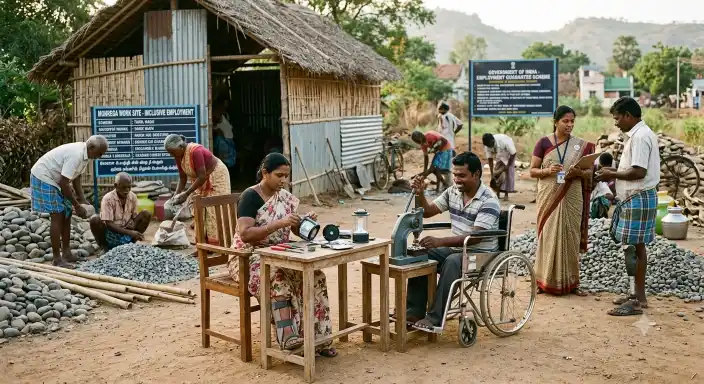
From July 1, the revamped framework under the Viksit Bharat–Guarantee for Rozgar and Ajeevika Mission (Gramin), or VB-GRAM G, will include a dedicated vertical for divyangjan, individuals with severe illnesses, and elderly workers. The initiative aims to make rural employment more inclusive by aligning work assignments with specific abilities.
Flexible Work and Attendance Norms
Under the new structure, eligible workers may be exempted from standard attendance requirements or allowed alternative attendance mechanisms. Officials said this flexibility is intended to ensure greater participation of vulnerable groups in the rural employment programme.
The scheme replaces the Mahatma Gandhi National Rural Employment Guarantee Act (MGNREGA), 2005, following its enactment in 2025. It expands guaranteed employment from 100 to 125 days and revises funding responsibilities, with the Centre contributing 60 percent of wage costs in most states and 90 percent in northeastern and Himalayan regions.
Inclusive Productivity Framework
A key feature of the new policy is a differentiated schedule of rates that aligns productivity benchmarks with the abilities of workers with disabilities. This ensures they receive full notified wages without being disadvantaged by standard labour norms.
Rural development secretary Rohit Kansal said the framework is designed to promote dignity and economic participation through disability-friendly work options, priority access to livelihood assets, and capacity-based job allocation.
India has an estimated 26.8 million persons with disabilities, with nearly 70 percent living in rural areas, according to the 2011 Census. Officials said traditional productivity standards have often limited their participation in employment schemes.
Flexible Roles and Wage Structure
Under VB-GRAM G, PwDs will be assigned to roles suited to their capacities, including supervisory and support functions, rather than physically intensive labour. They will not be required to follow fixed working hours to receive full wages.
The proposed wage structure ensures full payment of the notified daily wage, currently estimated between ₹241 and ₹400 depending on the state, once the schedule of rates is finalised.
Targeted Support and Identification System
The scheme also prioritises households with divyangjan for asset-based support, with work allocated closer to their residence. Special Gramin Rozgar Guarantee Cards will be issued to help identify beneficiaries, track entitlements, and assign suitable work. These cards will differ in colour from standard job cards.
Officials said a dedicated digital system will help monitor participation and ensure proper allocation of work under the new framework.
Infrastructure and Rural Development Goals
VB-GRAM G aims to strengthen rural livelihoods through infrastructure creation, including skill centres, self-help group facilities, livestock and fisheries units, rural markets, storage systems, and value-addition hubs.
The government has proposed an allocation of ₹1.51 trillion for the scheme in FY27, with ₹95,692 crore contributed by the Centre. In comparison, MGNREGA received ₹86,000 crore in FY25 and the same allocation continued in FY26.
Expert Views on Implementation Challenges
While disability rights experts have welcomed the move, they have stressed that execution will be critical. Concerns remain over identification of eligible beneficiaries and proper classification in rural areas.
Experts have also pointed out that adequate funding, training, and task design will be essential to ensure that work is genuinely aligned with individual abilities rather than standard labour expectations.
Despite concerns, the policy is seen as a significant shift toward inclusive rural employment, with implementation set to determine its long-term impact.
