


India and Japan are preparing to push forward a plan to enable trade settlements directly in their local currencies, allowing transactions between the yen and rupee without relying on the US dollar, according to a Nikkei Asia report ahead of Japanese Prime Minister Sanae Takaichi’s visit to New Delhi.
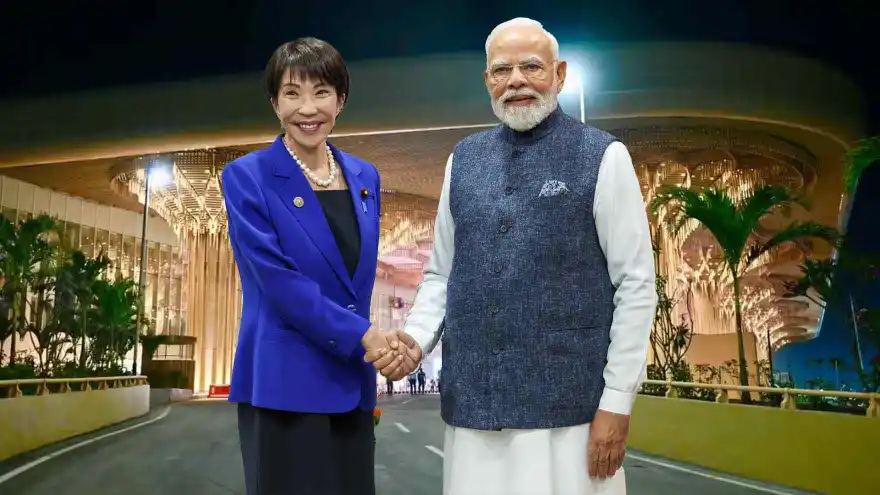
The proposal is expected to be discussed during the 16th India–Japan Annual Summit between Prime Minister Narendra Modi and PM Takaichi, and may even be included in the joint statement issued after their meeting. If included, it would mark the first time currency cooperation is formally reflected in a leaders’ statement between the two countries.
Push for Direct Currency Trade Mechanism
Under the proposed framework, Japanese non-residents would be able to open accounts with Indian banks, enabling financial institutions in both countries to settle cross-border payments directly in yen and rupees. This would remove the need for dollar-based routing and is expected to make trade and investment flows faster and more efficient.
The system is aimed particularly at supporting Japanese companies expanding their presence in India, reducing transaction costs and simplifying payment processes.
The idea builds on the 2025 Japan–India Joint Vision, which first mentioned deeper currency cooperation. Its possible inclusion in the upcoming summit outcome would signal a major step forward in financial integration between the two countries.
Japan has already implemented a similar local-currency settlement system with Indonesia in 2019, where bilateral transactions reached $7.7 billion in 2025. It is also exploring similar arrangements with Malaysia.
Takaichi’s India Visit and Summit Agenda
Japanese Prime Minister Sanae Takaichi will visit India from July 1 to July 3 at the invitation of PM Modi for the 16th annual summit. The visit aims to strengthen cooperation across trade, investment, defence, and economic security, the Ministry of External Affairs said.
The Japanese Foreign Ministry said both leaders will focus on expanding cooperation under the Japan–India Joint Vision for the Next Decade, including energy security, economic growth, and innovation. The discussions will also support the broader goal of a “Free and Open Indo-Pacific.”
Expanding Strategic and Economic Partnership
India and Japan share a Special Strategic and Global Partnership that covers infrastructure, defence, clean energy, technology, and trade. Bilateral trade stood at $27.5 billion in fiscal year 2025–26, while Japanese investment in India reached $3.2 billion between April and December 2025.
Japan remains one of India’s largest investors, supporting major projects such as the Mumbai–Ahmedabad high-speed rail corridor. Japanese firms have also increased investments in Indian companies, including a $1.6 billion stake purchase in Yes Bank.
In the previous summit, Japan announced plans to invest 10 trillion yen in India over the next decade. Both sides also agreed on a long-term roadmap to deepen economic and defence cooperation.
About 1,400 Japanese companies currently operate in India, nearly half in the manufacturing sector, highlighting the scale of economic engagement between the two countries.
