


The Delhi government on Monday notified its new Electric Vehicle (EV) policy, setting a clear direction toward a fully electric transport ecosystem in the national capital while excluding subsidies for hybrid vehicles.
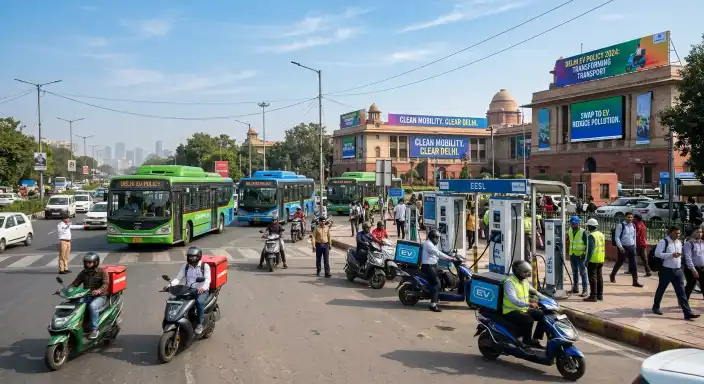
Chief Minister Rekha Gupta announced that the Cabinet has approved the policy with a ₹7,000 crore implementation budget, part of a larger ₹15,000 crore overall investment that will also cover charging infrastructure development, vehicle scrappage incentives, and purchase subsidies.
Phased Shift to Electric Mobility
The policy lays down strict timelines for transitioning different vehicle categories to electric. From January 1, 2027, only electric three-wheelers and N1 category trucks will be eligible for registration in Delhi. From April 1, 2028, only electric two-wheelers will be registered in the city.
School transport fleets will also be required to convert at least 10 percent of their vehicles to electric within two years of the policy’s notification. However, existing internal combustion engine vehicles already registered will be allowed to operate for their full lifecycle.
Calling the initiative “transformative and revolutionary,” the Chief Minister said the policy is aimed at significantly reducing air pollution and improving urban air quality. It will come into effect from July 1, 2026, and remain in force until March 31, 2030.
Focus on High-Emission Vehicle Segments
According to the transport department, commercial goods carriers and two- and three-wheelers contribute a significant share of Delhi’s air pollution. Officials said the policy is specifically designed to target these segments and accelerate their transition to electric mobility.
Transport Secretary Niharika Rai said the government aims to convert the entire fleet of these high-emission categories into EVs over time.
Incentives, Subsidies and Revenue Impact
The government has earmarked ₹7,000 crore for implementation, including ₹3,000 crore for purchase and scrappage incentives and around ₹1,000 crore for charging infrastructure. Officials estimate a revenue loss of about ₹3,000 crore due to exemptions in road tax and registration fees for EVs.
These exemptions will apply to electric cars priced up to ₹30 lakh (ex-showroom).
Purchase incentives will be provided in a phased manner: up to ₹30,000 for electric two-wheelers in the first year, reducing over subsequent years. Three-wheelers and N1 commercial trucks will also receive structured subsidies, with the highest benefits offered in the initial phase of the policy.
Additional scrappage incentives will be provided for older vehicles, including those below BS-IV emission standards, with higher payouts for commercial categories.
Charging Network Expansion and Infrastructure Push
To support the transition, the government plans to install 32,000 charging points across Delhi over the next four years. Funding will come from a mix of the PM e-Drive scheme and the Delhi government’s budget.
Delhi Transco Ltd will lead the development of charging infrastructure in coordination with the power department and distribution companies.
Digital Monitoring and Policy Execution
A dedicated EV portal will track vehicle registrations and subsidy claims. Consumers will be required to upload documents to avail benefits, with subsidies processed through direct benefit transfer within 60 days of approval.
Officials also confirmed that no incentives will be extended to hybrid vehicles under the new framework.
Targeted Benefits for Freight Vehicles
Electric N2 trucks will receive additional benefits, including exemption from “No Entry” restrictions for 10 years, though this applies only to the first 1,000 units purchased within three months of policy notification.
With structured incentives, strict timelines, and large-scale infrastructure expansion, the Delhi EV policy marks one of the most ambitious urban mobility transitions in the country.
