


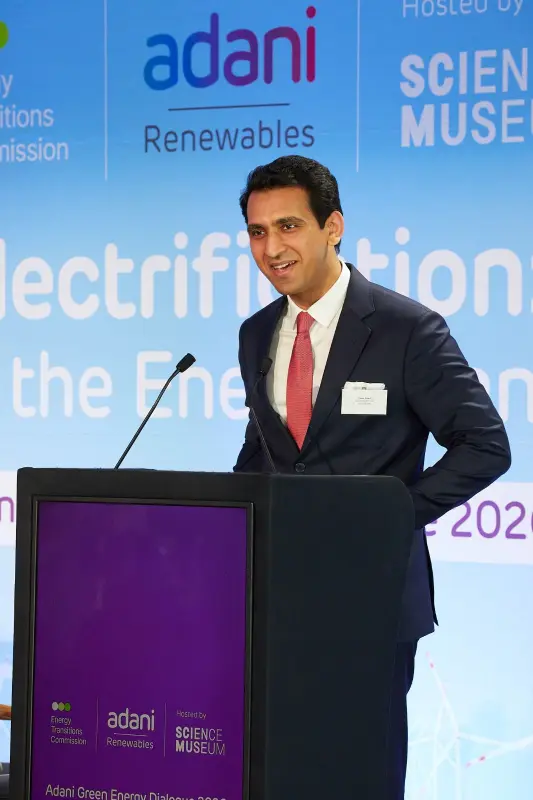
India must add nearly 2,000 gigawatts of new power generation capacity over the next two decades to meet rapidly rising electricity demand and reduce dependence on imported fuels, according to Adani Green Energy Executive Director Sagar Adani. He said electrification is the clearest path toward long-term energy security for the country.
Rising demand and energy challenge
Speaking at the inaugural Adani Green Electrification Dialogue in London, he said India faces a dual challenge of meeting surging power demand while keeping energy affordable, accessible, and clean amid global geopolitical uncertainty.
He noted that India consumed about 10,000 terawatt-hours of energy in 2024, compared to China’s 32,810 terawatt-hours, highlighting the scale of future demand growth as incomes and consumption rise.
Electrification as the core strategy
Adani stressed that India must “electrify everything” to reduce structural dependence on imported energy and build a domestic energy backbone based on local resources. He said electrification is becoming essential for energy independence and economic growth.
Balanced energy mix required
Calling for a pragmatic transition strategy, he said India must rely on a mix of renewables, hydro, efficient thermal power, and nuclear energy, warning that without stable baseload power, the energy system cannot remain reliable at scale.
He also emphasized the importance of energy storage technologies such as battery energy storage systems and pumped storage projects, which make renewable energy available round the clock.
Strong policy support over the decade
He credited government reforms over the past ten years for improving the investment environment through transmission expansion, renewable energy growth, infrastructure upgrades, and regulatory changes.
Adani Group’s expansion plans
Outlining the group’s roadmap, he said Adani Green Energy is targeting 50 GW of renewable capacity by 2030 and plans to build a 10 GW nuclear energy portfolio by 2035, alongside major investments in transmission, storage, and green hydrogen.
He added that the Adani Group has committed over $100 billion toward the energy transition, describing it as one of the largest private-sector commitments globally.
Call for collective global effort
Adani said India’s energy transition cannot be achieved by any single company and will require collaboration between governments, industry, and financial institutions.
He stressed that achieving energy security, affordability, and sustainability will require coordinated policy support and large-scale global investment.
Global dialogue on clean energy transition
The discussion took place at the Adani Green Energy Dialogue during London Climate Action Week, bringing together policymakers, investors, and climate experts to discuss strategies for accelerating clean electrification and energy transition worldwide.
Experts at the event highlighted that electrification of transport, heating, and industry is already becoming economically viable and will be key to achieving global decarbonisation goals.
