


India and Sweden have agreed to elevate their bilateral relationship to a Strategic Partnership following detailed discussions between Prime Minister Narendra Modi and Swedish Prime Minister Ulf Kristersson. The decision reflects a growing alignment between the two countries on technology, trade, innovation, and global economic cooperation. Prime Minister Modi, during his visit to Sweden, also urged European manufacturers to expand investments in India, highlighting that the country’s reform agenda is progressing rapidly and opening new opportunities across sectors.
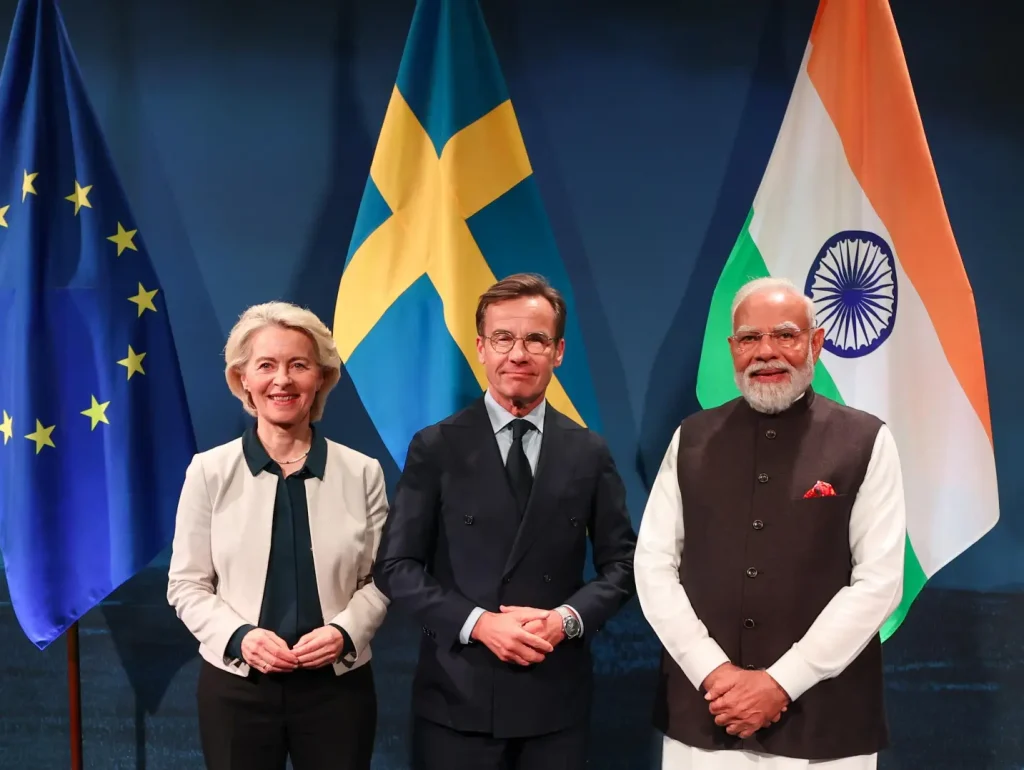
Strategic Partnership and New Cooperation Frameworks
Both sides announced a major upgrade in ties, accompanied by new initiatives such as the Joint Innovation Partnership 2.0 and the India–Sweden Technology and Artificial Intelligence Corridor. Leaders also set an ambitious target to double bilateral trade over the next five years. Modi said the outcomes of the visit would give fresh momentum to the relationship, pointing to expanded collaboration in advanced technology, clean energy, and industrial innovation.
Recognition and Diplomatic Engagement
During the visit, Prime Minister Modi was honoured with the Royal Order of the Polar Star (Commander Grand Cross), one of Sweden’s highest civilian awards, in recognition of his role in strengthening India–Sweden relations. He also addressed the European Round Table for Industry in Gothenburg, where senior European leaders and global business executives gathered to discuss future economic cooperation.
India’s Reform Push and Investment Pitch
At the business forum, Modi emphasized that India has spent the last 12 years focused on reforms, performance, and transformation. He described this journey as a “reform express” moving at full speed under strong political commitment. He positioned India as a major global destination for manufacturing and innovation, pointing to rapid economic growth, expanding infrastructure, and digital public services as key advantages.
Key Sectors for Collaboration
Modi invited European companies to expand cooperation in several high-growth areas, including telecom and digital infrastructure, electronics manufacturing, artificial intelligence, green energy, mobility solutions, urban development, healthcare, and life sciences. He stressed that the next wave of global innovation should be co-created in India, encouraging deeper integration in research and development ecosystems.
Strengthening India–EU Economic Architecture
The Prime Minister also highlighted the recently concluded India–European Union Free Trade Agreement, describing it as a transformative step in economic relations. He noted that both sides are working to implement it swiftly. Connectivity initiatives such as the India–Middle East–Europe Economic Corridor were also cited as important drivers of future trade and investment flows.
Vision for Future Cooperation
Modi reiterated India’s development vision of “Design for India, Make in India, and Export from India,” inviting European firms to become long-term partners in this journey. He also proposed regular India–Europe CEOs roundtables and suggested establishing a dedicated India desk within European industry platforms to deepen institutional engagement.
Expanding Industrial and Innovation Ties
In separate interactions with Swedish business leaders alongside Crown Princess Victoria and Prime Minister Kristersson, Modi noted that India–Sweden relations have evolved beyond traditional trade into a broader innovation-led partnership. Discussions focused on clean energy, sustainable mobility, resilient supply chains, life sciences, and advanced digital technologies, reinforcing both countries’ shared focus on sustainability and technological growth.
