


After staying unchanged for over two years, state-run oil marketing companies have finally revised fuel prices. Petrol and diesel prices were increased by about ₹3 per litre, marking the end of a prolonged freeze that had kept retail rates steady despite global volatility in crude oil markets.
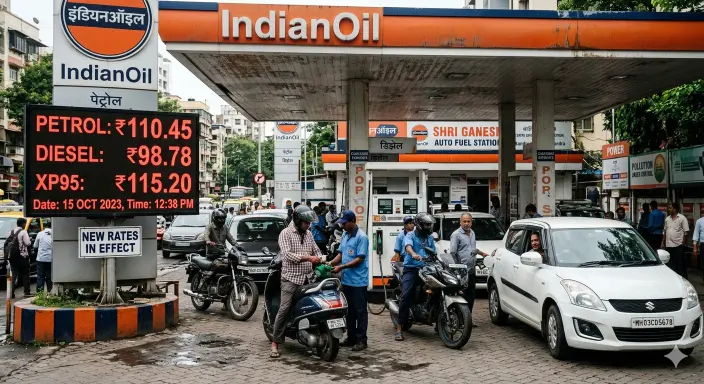
The timing of the revision has drawn attention as it comes shortly after the conclusion of key state assembly elections in Assam, Kerala, Tamil Nadu, and West Bengal. Voting in phases wrapped up between early and late April, and the price adjustment followed about 16 days after the final phase.
New petrol and diesel rates across major cities
In the national capital, petrol is now priced at ₹97.77 per litre, while diesel stands at ₹90.67 per litre.
Metro cities have also seen similar upward revisions:
- Kolkata: petrol at ₹108.74 per litre, up by ₹3.29; diesel at ₹95.13, up by ₹3.11
- Chennai: petrol at ₹103.67 per litre, higher by ₹2.87; diesel at ₹95.25, up by ₹2.86
The changes reflect a uniform upward revision across regions, though final retail prices still vary depending on local VAT and state-level taxes.
Why prices were held back for so long
Fuel prices in India are technically market-linked and can be revised daily based on global crude oil trends. However, in practice, they often remain unchanged for long stretches due to political sensitivity.
According to the government, public sector oil marketing firms — Indian Oil Corp Ltd, Bharat Petroleum Corp Ltd, and Hindustan Petroleum Corp Ltd — had been absorbing heavy losses during this period.
Estimates suggest these companies were losing around ₹20 per litre on petrol and nearly ₹100 per litre on diesel, mainly because global crude prices remained high while retail prices in India stayed unchanged.
Excise duty cut delayed retail pressure
To cushion the impact of rising global oil prices, the finance ministry reduced excise duty on petrol and diesel by ₹10 per litre in March. That move helped delay an immediate increase at the pump, but it did not fully offset mounting pressure from international crude trends.
Private players had already moved earlier
While state-run firms held prices steady, some private fuel retailers had already begun increasing rates.
Nayara Energy raised petrol prices by about ₹5 per litre and diesel by ₹3 in March, with rates crossing ₹100 per litre in several states depending on local taxation.
Similarly, Shell implemented sharper revisions in early April, increasing petrol by over ₹7 per litre and diesel by as much as ₹25 per litre in some locations. In Bengaluru, for instance, petrol climbed close to ₹120 per litre, while diesel moved even higher due to global cost pressures and operational pricing differences.
How pricing really works behind the scenes
Even though deregulation allows daily revision based on a 15-day average of crude oil prices, retail pricing in India tends to be adjusted cautiously.
This is largely because fuel affects transport costs, inflation, and household budgets almost immediately. As a result, pricing decisions are often spaced out, especially when global oil markets are unstable.
OMC losses and pressure from crude oil
The financial strain on oil marketing companies has been building for months. High crude oil prices combined with stagnant retail rates have led to large under-recoveries.
Recent estimates suggest that if crude remains elevated, marketing margins could turn sharply negative, leading to losses on every litre sold. In extreme scenarios, petrol losses could reach double digits per litre, with diesel even worse.
Senior officials in the Ministry of Petroleum and Natural Gas have also acknowledged that the sector is facing monthly losses running into tens of thousands of crores across petrol, diesel, and LPG.
Global crude trends and economic warnings
International oil prices have remained volatile due to geopolitical tensions and supply disruptions. India’s crude basket has hovered above $100 per barrel in recent months, keeping import costs elevated.
Economic analysts have warned that sustained high crude prices could worsen inflation and widen the country’s import bill. Even a small rise in oil prices has a large macroeconomic effect because India imports most of its crude requirement.
Inflation and growth concerns
Higher fuel prices tend to ripple through the economy. Transport costs rise, logistics become more expensive, and consumer prices often follow.
Studies by financial institutions suggest that even a $1 increase in crude prices can add thousands of crores to India’s annual import bill. This creates pressure on both inflation and fiscal balance, especially when prices remain elevated for long periods.
Government view: price adjustment is unavoidable
Officials in the finance ministry have indicated that passing global price increases to consumers may be unavoidable in the long run. The argument is that prolonged suppression of prices distorts demand and increases fiscal stress.
The broader view is that while timing can be managed, full insulation from global oil shocks is not sustainable indefinitely.
Prime Minister urges fuel discipline
Narendra Modi recently appealed to citizens to use fuel more responsibly. He suggested greater reliance on public transport, work-from-home arrangements where possible, and general reduction in fuel consumption to ease pressure on foreign exchange reserves.
The message ties into a wider concern: India’s large oil import dependence makes domestic consumption patterns closely linked to global economic stability.
What this means going forward
The latest revision signals a shift from prolonged price stability to gradual alignment with global crude realities. While the immediate increase is modest, it reflects deeper pressure building in the system — from oil company losses to global supply constraints.
For consumers, this likely means fuel prices will remain sensitive to global crude movements going ahead, with fewer long freezes like the one seen over the past two years.
