


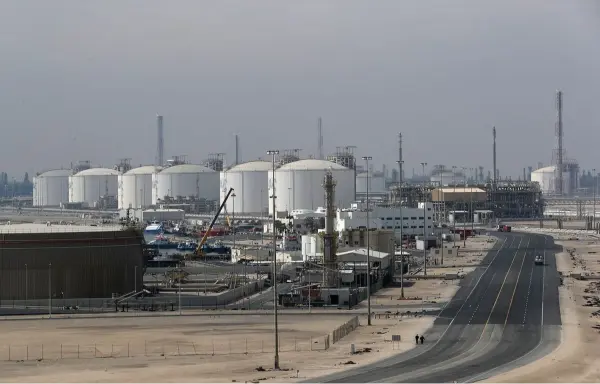
Qatar stopped its liquefied natural gas (LNG) production on Monday after Iranian attacks on Gulf countries, following Israeli and U.S. strikes on Iran. The precautionary shutdown affected Qatar’s Ras Laffan complex, a key hub that accounts for about 20% of global LNG supply, crucial for both Asian and European markets.
Ripple Effects Across the Middle East
The unrest has forced multiple shutdowns: Saudi Arabia’s largest domestic refinery was temporarily closed after a drone strike, most oil production in Iraqi Kurdistan halted, and several Israeli gas fields suspended operations, affecting exports to Egypt. QatarEnergy, whose clients are largely in Asia, prepared to declare force majeure on shipments due to the Iranian drone attacks.
Drones also struck the Mesaieed industrial zone in southern Qatar, home to petrochemical plants, though far from the main gas fields. European natural gas prices surged, with the Dutch TTF benchmark rising 46%, while oil prices jumped over 13% intraday, surpassing $82 a barrel, as shipping slowed in the Strait of Hormuz—a corridor for a fifth of the world’s oil supply.
Saudi and Iraqi Precautions
Saudi Aramco’s Ras Tanura refinery, part of a critical export hub, was shut down briefly as a precaution. Two drones were intercepted at the site, causing minor fires but no injuries. In Iraqi Kurdistan, companies including DNO, Gulf Keystone Petroleum, Dana Gas, and HKN Energy halted production at several fields, though no damage was reported.
Impact on Israeli and Iranian Energy Assets
Israel ordered Chevron to temporarily close the Leviathan gas field and Energean shut production at smaller fields. In Iran, explosions on Kharg Island, the hub for 90% of its crude exports, raised concerns about possible disruptions. Iran supplies around 4.5% of global oil, including crude, condensate, and other liquids.
Escalation Raises Regional Concerns
Analysts describe the attacks on Gulf energy infrastructure as a major escalation, signaling that Iran is targeting key energy assets. Past incidents, including the 2019 attacks on Abqaiq and Khurais and a 2021 assault on Ras Tanura by Yemen’s Houthis, highlight the vulnerability of the region’s energy facilities. Experts suggest these events may push Saudi Arabia and its neighbors closer to coordinating with the U.S. and Israel on military responses.
