


Vizhinjam International Seaport has emerged as one of India’s fastest-growing container transshipment hubs, setting multiple operational benchmarks in January 2026. Developed and operated by Adani Ports and Special Economic Zone Limited (APSEZ) under a PPP with the Government of Kerala, the port recorded its highest-ever monthly throughput of 123,092 TEUs. It also handled a record 62 vessels in a single month and achieved a peak Gross Crane Rate of 30.12 moves per hour, underscoring sharp gains in productivity within just over a year of commercial operations.
The port’s rapid rise is reflected in its global standing. Vizhinjam now ranks 83rd worldwide by container volumes and has handled 740 vessels and 1.57 million TEUs since operations began. As India’s first semi-automated container port, Vizhinjam is designed to handle next-generation vessels. Between December 2024 and January 2026, it serviced over 50 ultra-large container vessels exceeding 399 metres in length, including MSC IRINA, the world’s largest container ship, and MSC Verona, the deepest-draft vessel ever handled in South Asia.
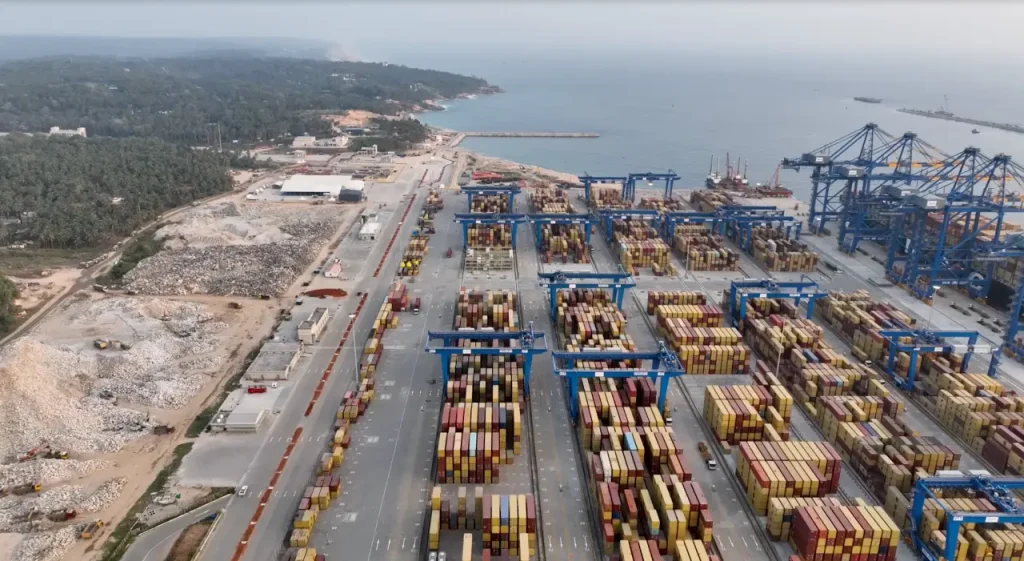
Technology and inclusivity underpin this performance. A Made-in-India Vessel Traffic Management System enhances safety and efficiency, while Vizhinjam has also become the country’s first container port to deploy women automated crane operators. Natural depths of 18–20 metres, minimal dredging needs, and proximity to key east–west shipping lanes further strengthen its competitiveness against global hubs such as Colombo, Dubai and Singapore.
Looking ahead, Vizhinjam is entering a major expansion phase. In January 2026, APSEZ committed ₹16,000 crore for Phase 2, extending berth length to 2,000 metres and increasing breakwater length to about 3,900 metres, with completion targeted by 2028. Once fully developed, capacity is expected to rise from 1 million TEUs to 5.7 million TEUs by 2029. Part of the Adani Group’s ₹30,000-crore investment pledge in Kerala, Vizhinjam stands as a cornerstone of port-led development, reinforcing India’s ambition to capture a larger share of global transshipment traffic.
