


The UAE and Oman are laying down tracks for something big: the first rail link crossing their shared border. It’s called Hafeet Rail, named after the rugged mountain range that straddles both countries. This is a joint venture between Etihad Rail, Oman Rail, and Mubadala Investment Company. With a $2.5 billion price tag (960 million Omani rials), the new 303-kilometre railway will connect Sohar Port in Oman to the Etihad Rail network in Al Ain. Of that, 238 km will run between Sohar and Abu Dhabi — cutting today’s road journey down to just over an hour and a half.
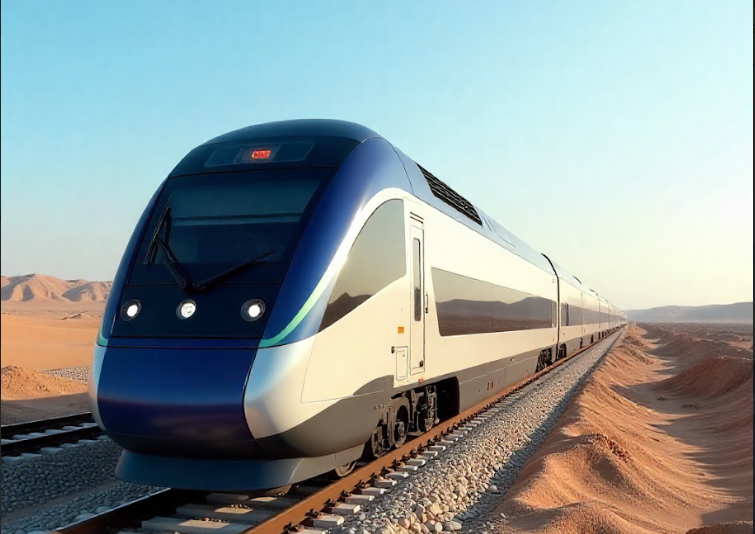
New Travel Times: Abu Dhabi to Sohar: 1 hour 40 minutes (was 3+ hours by road). Sohar to Al Ain: 47 minutes (down from 1 hour 27 minutes).
It’s a strategic move for both countries. For trade and tourism, it means uninterrupted cross-border travel, more bilateral investments, new integrated logistics hubs, and major infrastructure and job growth. For passengers, expect trains running up to 200 km/h, with comfortable, modern, and scenic journeys through the Jebel Hafeet region, making cross-border tourism and business travel much more appealing. For freight, the benefits are just as strong: 120 km/h cargo trains, 15+ terminals, connections to 5 ports, and faster, more efficient logistics across the board.
Hafeet Rail will connect directly to the Etihad Rail network, which is scheduled to launch passenger services in 2026, linking 11 cities across all seven emirates. Key highlights include the Abu Dhabi–Dubai high-speed line, which will cut travel time to just 30 minutes at 350 km/h, full integration with UAE ports and logistics hubs, and a unified fare system using the nol card.
Bottom line: Hafeet Rail isn’t just about getting from point A to B. It’s a leap forward in regional mobility, trade, and cooperation, with long-term impact across the Gulf.
