


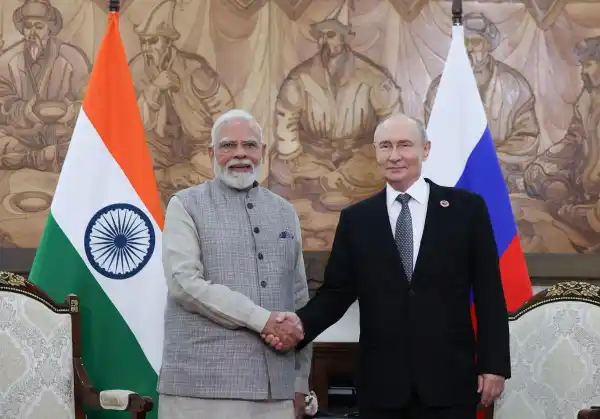
Prime Minister Narendra Modi and Russian President Vladimir Putin are expected to discuss major defence deals, including Russia’s S-500 missile defence system and Su-57 stealth fighter, during their meeting on the sidelines of the SCO Summit. The talks come as India looks to strengthen its defence partnership with Russia.
The discussions have gained importance after India’s S-400 missile defence systems reportedly performed well during Operation Sindoor. India currently operates four S-400 squadrons and is expected to receive the fifth and final squadron by November 2026. The Defence Ministry has also cleared a proposal to buy five more S-400 squadrons at a cost of more than ₹50,000 crore.
The S-500 could provide an additional layer of protection for India. While the S-400 is mainly designed to counter aircraft, drones, cruise missiles and other aerial threats, the S-500 is designed to deal with more advanced threats such as ballistic missiles and hypersonic weapons.
The S-500 is reportedly capable of intercepting targets at ranges of around 600 km and at much higher altitudes than the S-400. It is also being developed to operate in the near-space environment and could potentially target low-Earth-orbit satellites.
This means the S-500 would not replace the S-400. Instead, both systems could work together as part of a layered air-defence network. The S-500 could handle high-altitude and long-range threats, while the S-400 could continue protecting against conventional aerial attacks.
India may also explore producing the S-500 locally through a co-production arrangement with Russia. Such a deal could give India greater manufacturing capabilities and reduce dependence on direct imports.
The Russian Su-57 stealth fighter is another major defence platform being discussed. Russian officials have indicated that India could produce the aircraft under licence and potentially integrate Indian weapons into it.
The Su-57 discussion comes at a time when the Indian Air Force is facing a shortage of fighter squadrons. China is rapidly expanding its fifth-generation fighter fleet, while India’s indigenous fifth-generation fighter programme is expected to take several more years to enter service.
The Su-57 could therefore provide India with an interim fifth-generation fighter option while its own aircraft programme develops.
India and Russia are also discussing other areas of defence cooperation, including upgrading India’s Sukhoi-30MKI fighter fleet, improving radars and avionics, adding new weapons, and expanding military logistics cooperation.
Overall, the discussions show that India-Russia defence cooperation is moving beyond simple weapons purchases. Air defence, stealth fighters, local manufacturing, logistics and military modernisation are all becoming important parts of the relationship.
