


Twenty out of India’s 22 active satellites in Low Earth Orbit (LEO), which extends up to 2,000 km above Earth, face a higher risk of collision due to the increasing number of space objects in this region, Union Minister of State for Space Jitendra Singh informed the Lok Sabha.
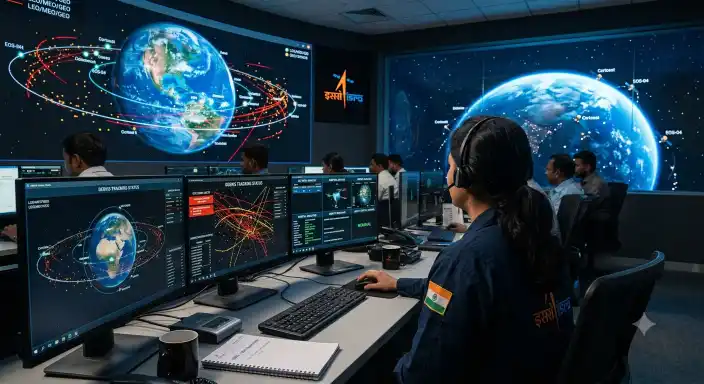
To reduce collision risks, the Indian Space Research Organisation (ISRO) carried out 20 Collision Avoidance Manoeuvres (CAMs) in 2025 and has already conducted nine such manoeuvres in 2026.
India is also actively participating in global efforts to manage space debris and improve space safety through international forums, including the Inter-Agency Space Debris Coordination Committee (IADC), United Nations Working Group on Long-Term Sustainability (UN-LTS), Space Situational Awareness (SSA) groups and other international space traffic management initiatives.
ISRO has contributed technical inputs to global space debris mitigation guidelines and has been working towards its Debris-Free Space Mission (DFSM) initiative announced in 2024. The goal is to ensure that both government and private Indian space missions contribute towards achieving zero debris in the future.
Currently, ISRO’s Multi-Object Tracking Radar (MOTR) at Sriharikota tracks large objects in Low Earth Orbit. The upcoming optical telescope at Hanle, Ladakh, under the Network for Space Object Tracking and Analysis (NETRA) project, is nearing completion and will help track objects as small as 30 cm or larger at Geostationary Orbit (GEO).
Gaganyaan Mission Progress
Providing an update on India’s human spaceflight programme, Jitendra Singh said ISRO is targeting the first uncrewed experimental mission of Gaganyaan in the fourth quarter of 2026. The mission will test key technologies, including the Vyommitra half-humanoid robot.
This will be followed by two additional uncrewed missions using the same configuration planned for the crewed mission, with India’s first human spaceflight mission targeted for 2027.
India’s Space Station Plans
The government is targeting the operationalisation of the Bharatiya Antariksh Station (BAS) by 2035. ISRO has designed the space station with five planned modules, and the development of the first module, BAS-01, has already received government approval.
System engineering work and technology development for various subsystems are currently progressing across ISRO centres. In September 2024, the Cabinet approved a budget allocation of ₹20,193 crore for eight space missions linked to India’s future space goals.
Global Partnerships for Human Space Missions
ISRO is collaborating with multiple international space agencies to support the Gaganyaan programme.
The European Space Agency (ESA) is providing network operations support for Gaganyaan missions, while cooperation with the Australian Space Agency focuses on crew and crew module recovery operations.
Partnerships with France’s CNES have supported training programmes for flight surgeons and ground support teams. ISRO has also signed an agreement with Russia’s Roscosmos for joint activities in human spaceflight, including support for crew seats, space suits, testing facilities and astronaut training.
These collaborations are aimed at strengthening India’s capabilities in human spaceflight, space safety and future exploration missions.
