


The National Highways Authority of India (NHAI) has announced plans to deploy and upgrade Advanced Traffic Management Systems (ATMS) across 1,205 km of national highways in the Delhi-NCR region. The initiative, announced on June 24, aims to transform highways into a smart, technology-driven transport network.
Focus on Real-Time Monitoring and Road Safety
The upgraded system will enable real-time traffic monitoring, faster incident response, improved enforcement of traffic rules, and better flow of information to commuters. It will also support data-driven decision-making to improve highway operations and safety.
What is ATMS
Advanced Traffic Management Systems use cameras, sensors, communication networks, and artificial intelligence to monitor traffic conditions, detect incidents, enforce regulations, and provide live updates to road users.
The system helps identify accidents, congestion, breakdowns, and violations quickly, improving both safety and traffic movement.
Key Components of the System
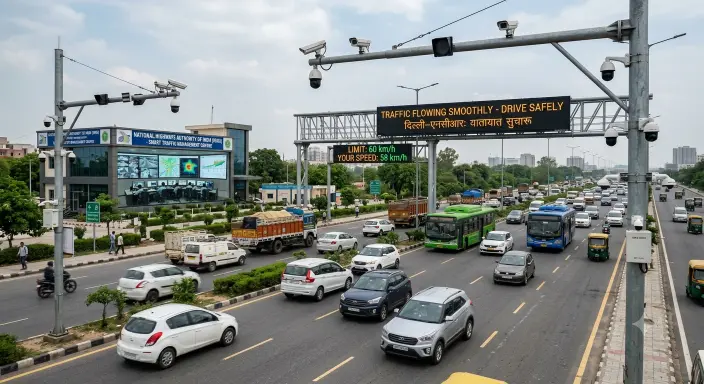
The ATMS network will include Traffic Monitoring Camera Systems for 24/7 surveillance, Video Incident Detection and Enforcement Systems to identify violations and accidents, Vehicle Actuated Speed Displays for driver alerts, and Variable Message Signboards for real-time traffic updates.
The entire system will be supported by a high-speed optical fibre communication network and integrated with the e-Challan platform for digital enforcement.
Coverage Across NCR Highways
In the first phase, ATMS will be deployed and upgraded across 1,205 km of highways in Delhi-NCR and nearby regions.
Around 408 km will receive full deployment of all components, while 797 km of existing corridors will be upgraded with advanced video detection systems.
Key corridors include Delhi-Gurgaon-Kotputli (NH-48), Delhi-Meerut Expressway, Delhi-Saharanpur highway, and routes across Rewari, Mathura, Ghaziabad, Meerut, and Haryana regions.
AI-Driven Command and Control System
NHAI will establish a multi-level Command and Control Centre structure, including local, regional, and national monitoring hubs.
A major Regional Control Centre will be set up in Sohna to manage corridor-level operations and incident response, while smaller centres will be placed every 75–100 km for real-time monitoring and faster action.
Broader Smart Transport Push
The initiative comes alongside other smart mobility projects, including the Chennai Intelligent Transport System, which has received central approval and is expected to be fully operational by August 2026.
