


India and the United Kingdom are well placed to build a more forward-looking and mutually beneficial partnership, External Affairs Minister S Jaishankar said on Thursday, highlighting the momentum created by the recently finalised trade agreement and defence industrial roadmap.
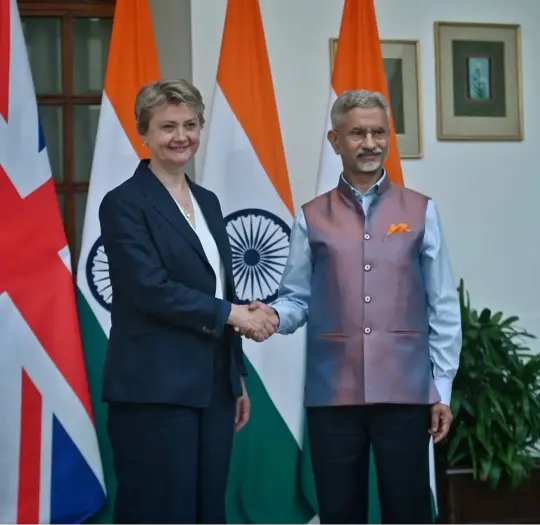
He made the remarks during talks with visiting UK Foreign Secretary Yvette Cooper, noting that the bilateral relationship is entering a phase shaped by shared economic and strategic priorities.
New maritime and critical minerals initiatives
During the visit, both sides signed a memorandum of understanding to establish a Regional Maritime Security Centre of Excellence. The centre will focus on building capacity among Indian Ocean countries to respond to non-traditional maritime threats and will be developed by King’s College London in collaboration with India’s National Maritime Foundation.
In another key development, India and the UK launched the Critical Minerals Global Supply Chain Observatory to strengthen cooperation in securing essential minerals and building resilient global supply chains, particularly for clean energy and advanced technologies.
Leadership meetings highlight growing alignment
UK Foreign Secretary Yvette Cooper also met Prime Minister Narendra Modi, who welcomed the strengthening of bilateral ties and said the India-UK Vision 2035 would guide future cooperation across key sectors.
Following his discussions, Jaishankar said the two countries reviewed progress in areas including trade, technology, defence, climate action, education, supply chains and people-to-people links. He also pointed to emerging opportunities in clean energy, artificial intelligence and critical minerals.
Expanding strategic and economic engagement
The two sides exchanged views on global developments, including the conflicts in Ukraine and West Asia, as well as broader Indo-Pacific security dynamics.
Jaishankar described recent developments in bilateral ties as significant, referencing the Prime Minister’s visit to the UK last year and the UK Prime Minister’s subsequent visit to India. He said the finalisation of the Comprehensive Economic and Trade Agreement, along with the strategic partnership and defence industrial roadmap, marked key milestones in the relationship.
He added that the trade agreement strengthens supply chain resilience and addresses concerns related to energy, food and economic security, shifting the relationship towards a more future-oriented economic partnership.
Vision 2035 and long-term cooperation
Jaishankar said the India-UK Vision 2035 framework outlines five key pillars of cooperation, including growth, technology and innovation, defence and security, climate and clean energy, and education.
He also noted expanding educational collaboration, including plans by the University of Liverpool to establish a campus in India.
UK highlights economic security focus
Yvette Cooper said India-UK relations have strengthened significantly in recent years, with the trade agreement serving as a key driver of economic growth.
She emphasised that cooperation on critical minerals and supply chain resilience is central to economic security and highlighted the importance of better information-sharing and access to resources for supporting sustainable growth and technological development.
The Critical Minerals Global Supply Chain Observatory, launched during the visit, is expected to play a key role in strengthening collaboration and supporting stable global supply chains essential for clean energy transition and advanced manufacturing.
