


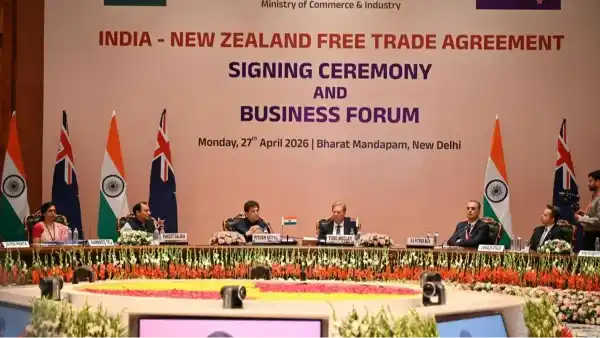
India and New Zealand on Monday signed a long-anticipated Free Trade Agreement (FTA) in the presence of Commerce and Industry Minister Piyush Goyal and New Zealand’s Trade and Investment Minister Todd McClay. The deal marks a significant step in strengthening economic ties between the two nations.
Boosting Trade and Investment
The agreement aims to double bilateral trade from current levels and attract nearly USD 20 billion in investment into India over the next 15 years. At present, trade between the two countries stands at about USD 2.4 billion, with merchandise trade accounting for USD 1.3 billion in 2024–25.
Under the FTA, all Indian exports to New Zealand will receive duty-free access. This is expected to benefit labour-intensive industries such as textiles, leather, plastics, and engineering goods.
Opportunities in Services and Mobility
India has secured expanded access in key services sectors, including IT and IT-enabled services, education, financial services, tourism, construction, and professional services.
A notable feature of the agreement is a temporary mobility pathway, allowing up to 5,000 Indian professionals to work in New Zealand for up to three years.
Market Access for New Zealand Goods
India will open around 70 percent of its tariff lines to New Zealand, following a framework similar to its agreement with Australia. Tariff reductions will apply to products such as apples, kiwifruit, manuka honey, wool, and sheep meat.
Import duties on certain industrial inputs like iron, steel, and aluminium scrap will be reduced gradually over a period of up to 10 years.
Protection for Sensitive Sectors
India has protected key domestic industries by excluding items such as dairy products, pulses, sugar, edible oils, gems and jewellery, and certain metals. Some agricultural products will also remain subject to tariff-rate quotas and minimum import price controls.
Comprehensive Trade Framework
The agreement spans 20 chapters covering goods, services, rules of origin, customs procedures, sanitary measures, dispute settlement, and legal cooperation.
Officials from both sides said the pact will strengthen supply chains, open new business opportunities, and deepen long-term economic cooperation, while supporting India’s broader Indo-Pacific trade strategy.
