


India and Canada on Monday signed key agreements on uranium and critical minerals and committed to finalising a Comprehensive Economic Partnership Agreement (CEPA) this year. Prime Minister Narendra Modi and Canadian Prime Minister Mark Carney laid out a roadmap to deepen bilateral cooperation and aim to raise annual trade to USD 50 billion by 2030, up from the current USD 13 billion.
Expanding Economic and Energy Cooperation
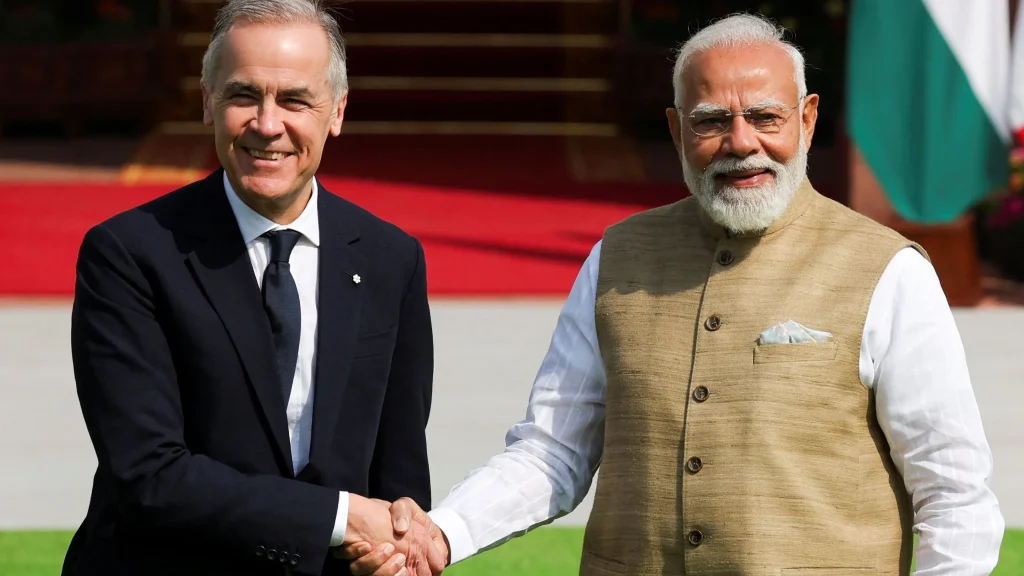
The two leaders announced a new strategic energy partnership covering LNG, LPG, uranium, solar, hydrogen, and other clean energy sources. A landmark USD 2.6 billion deal with Saskatoon-based Cameco will supply nearly 22 million pounds of uranium to India from 2027 to 2035, supporting civil nuclear energy development.
India and Canada also signed six other MoUs, including one outlining the CEPA framework, with both leaders emphasising that unlocking economic potential will create investment and employment opportunities in both countries.
Focus on Defence, Security, and Critical Technologies
Modi and Carney pledged to strengthen cooperation in defence, critical technologies, and small and modular nuclear reactors. They agreed to launch an India-Canada defence dialogue to enhance maritime domain awareness, military exchanges, and defence industry collaboration. Both sides highlighted shared concerns over terrorism, extremism, and radicalisation, pledging close coordination to promote global peace and security.
Education, Research, and People-to-People Ties
The leaders announced new collaborations in AI, healthcare, agriculture, and innovation, with Canadian universities planning campuses in India. A Talent and Innovation Strategy will support education, research, and cultural exchanges, aiming to build stronger people-to-people connections.
Clean Energy and Critical Minerals
The two countries signed agreements to advance cooperation across clean energy, conventional energy, civil nuclear energy, and critical minerals. Canada will support secure supply chains for clean energy, electric vehicles, and advanced manufacturing, while both sides plan joint work on wind, solar, hydrogen, and energy storage.
Space and Technology Collaboration
The Indian Space Research Organisation and the Canadian Space Agency agreed to cooperate on earth observation and explore initiatives in space exploration and quantum technologies, leveraging space-based tools for innovation and disaster resilience.
Resetting Relations and Strengthening Diplomacy
Bilateral relations had suffered following the 2023 Khalistani-related diplomatic row. With Carney’s election and subsequent visits, both sides have taken steps to normalise ties, including reinstating high commissioners. Modi and Carney also discussed West Asia, reiterating India’s support for conflict resolution through dialogue and diplomacy to ensure the safety of Indian citizens abroad.
A Forward-Looking Partnership
The leaders described the agreements as the beginning of a new, prosperous chapter in India-Canada relations, offering generational opportunities for workers and businesses, while promoting sustainable development, global peace, and economic resilience. The joint focus spans energy security, clean technology, defence, education, space, and trade, reflecting mutual trust, shared democratic values, and a commitment to long-term cooperation.
