


British engineering major Rolls-Royce has joined hands with the Indian Institute of Technology Kanpur (IIT Kanpur) to develop research-led solutions for reducing noise inside aircraft cabins. The six-month project will focus on understanding Engine Vibration Related Noise (EVRN), a key factor affecting passenger comfort during flights.
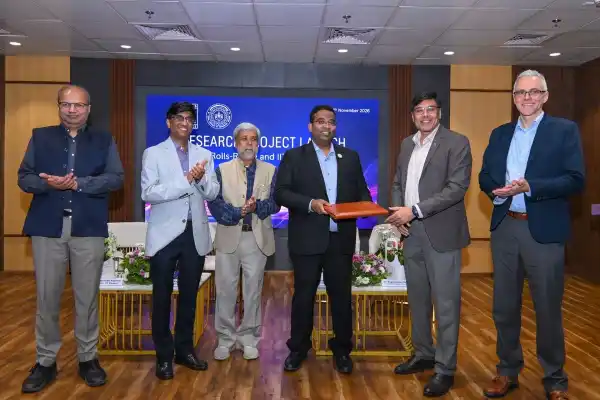
Announced on November 25, 2026, the initiative will combine Rolls-Royce’s numerical research methodology with IIT Kanpur’s experimental capabilities. Researchers will investigate how engine vibrations travel through an aircraft’s structure and contribute to noise inside the passenger cabin.
Experimental Aircraft Model to Study Engine Vibrations
The research team will establish an experimental aircraft fuselage model at IIT Kanpur to simulate an aircraft in flight. A mechanical vibration source will represent the engine, while advanced acoustic and vibration sensors will measure how vibrations move through the aircraft structure.
The project will validate a numerical methodology developed by Rolls-Royce through experimental testing. By studying the relationship between structural vibrations and cabin acoustics, researchers aim to generate insights that can support future noise-reduction strategies.
Part of Wider Rolls-Royce-IIT Kanpur Partnership
The research project builds on a broader Memorandum of Understanding signed between Rolls-Royce India and IIT Kanpur earlier in 2026.
The agreement provides a framework for joint research projects, internships, knowledge exchange and skill development. It also aims to connect academic research with industry requirements and strengthen India’s advanced engineering and manufacturing capabilities.
Sashi Mukundan, Executive Vice President of Rolls-Royce India, said the collaboration would support local research capabilities, innovation and the development of specialised talent.
Research Could Expand in Further Phases
IIT Kanpur Director Professor Manindra Agrawal said the project would combine numerical methods with experimental validation to generate reliable insights into vibration transmission and noise-reduction techniques.
The current initiative is Phase 1 of the research programme, with the possibility of additional phases based on its findings.
The collaboration highlights the growing role of industry-academia partnerships in India’s aerospace research ecosystem. It also creates opportunities for students and researchers to work on real-world engineering challenges while contributing to technologies that could improve aircraft cabin comfort.
