


Indian Railways is changing the onboard dining experience on three Vande Bharat Sleeper routes with the introduction of compact, flight-style meal menus. The Indian Railway Catering and Tourism Corporation (IRCTC) rolled out the revised menu from November 1, 2026, as part of a pilot project aimed at improving food quality and hygiene on long-distance trains.
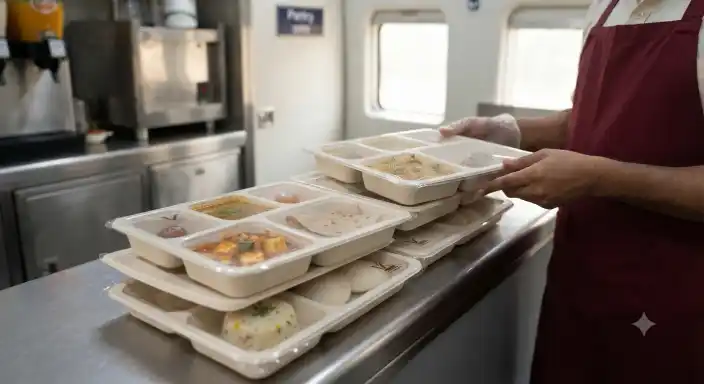
The new system offers fewer dishes for breakfast, lunch and dinner, allowing catering operators to focus on consistency and quality rather than managing an elaborate menu.
Three Vande Bharat Sleeper Routes Covered
The revised meal arrangement is currently being tested on three routes:
- Mumbai–Bengaluru
- Howrah–Kamakhya
- New Delhi–Varanasi
Meals are being prepared by specialised cloud kitchens instead of relying entirely on traditional onboard catering arrangements. IRCTC has partnered with the Mayfair Group for the Kamakhya route, TajSATS for Howrah and Sarovar Portico Group for the other two routes.
Fewer Dishes on the Menu
On the Mumbai–Bengaluru route, breakfast options have been reduced to idli and vada with chutney and sambar, poha or upma.
Lunch and dinner now include chapati, rice, dal and one main dish, with passengers choosing between chicken and a vegetarian option.
Several items from the earlier menu have been removed. These include soups, omelettes, sandwiches, buttermilk and chocolates at breakfast, along with dry vegetables, curd, salads, pickles and sweets for lunch and dinner.
Meal Weight Reduced, Portion Sizes Unchanged
The overall weight of an individual meal has come down from around 700–750 grams to 450–500 grams. However, IRCTC officials have clarified that the portion size of individual dishes remains unchanged.
The aim is to simplify meal preparation and make it easier to monitor food quality across the services.
IRCTC Reports 10% Drop in Food Complaints
The change follows repeated passenger complaints about food quality and hygiene on long-distance trains. According to Gaurav Jha, Group General Manager of IRCTC’s West Zone, food-related complaints have declined by 10% since cloud kitchens began supplying meals under the new arrangement.
IRCTC is currently assessing passenger feedback and the results of the pilot project. If the initiative proves successful, the compact menu model could be extended to other long-distance and premium train services.
The move signals a shift in railway catering towards specialised food preparation, simplified menus and closer quality monitoring.
