


The Indian Institutes of Technology (IITs) are set to expand specialised academic programmes in Robotics, Physical Artificial Intelligence (AI) and Space Engineering, with around 6,000 student opportunities planned from 2027.
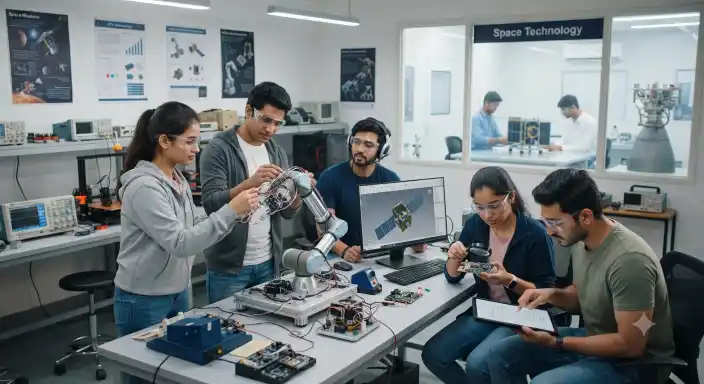
The initiative is being supported by the Bhupat and Jyoti Mehta Family Foundation in partnership with multiple IITs. It aims to build capacity across undergraduate, postgraduate and doctoral programmes over the next eight to ten years, with more than 120 dedicated faculty members expected to support the programmes.
The proposed expansion includes 5,000 places in Robotics and Physical AI and another 1,000 in Space Engineering and Technology.
5,000 Places in Robotics and Physical AI
The Robotics and Physical AI programmes will account for the largest share of the planned expansion. The proposed distribution is:
| Programme | BTech | Master’s | PhD | Total |
| Robotics and Physical AI | 2,500 | 1,200 | 1,300 | 5,000 |
| Space Engineering and Technology | 500 | 300 | 200 | 1,000 |
| Total | 3,000 | 1,500 | 1,500 | 6,000 |
The curriculum will combine mechanical and electrical engineering with software, machine learning, computer vision, sensing and control systems. Students will gain exposure to both hardware and software development.
Advanced research areas will include foundation models, digital twins, humanoid and legged robots, swarm robotics and soft robotics.
Focus on Healthcare, Defence and Manufacturing
The programmes are designed to connect academic learning with practical applications across sectors such as healthcare, defence, agriculture and industrial manufacturing.
Students are expected to work on industry-linked projects and have opportunities for a paid industry-residency semester at a participating IIT.
The curriculum will also address challenges specific to Indian conditions, including heat, dust, power availability and cost constraints. Potential applications include agricultural automation, rural healthcare and robotics solutions for small manufacturers.
1,000 Opportunities in Space Technology
The initiative will also create 1,000 academic opportunities in Space Engineering and Technology across BTech, master’s and doctoral programmes.
A School of Space Science and Technology is planned at one of the participating IITs. Its proposed focus areas include satellite navigation, space robotics and human spaceflight.
The IIT that will host the school and the individual institutions introducing the programmes have not yet been announced.
Foundation Builds on Existing IIT Partnerships
The new initiative extends the foundation’s existing work with India’s leading technical institutions.
Since 2019, the Bhupat and Jyoti Mehta Family Foundation has partnered with six IITs to establish eight schools and centres focused on Data Science and Artificial Intelligence, Healthcare and Biomedical Engineering, and Sustainability.
These programmes have recorded more than 4,000 admissions across BTech, MTech and PhD courses.
The foundation plans to extend this academic partnership to emerging fields such as Robotics, Physical AI and Space Technology, creating opportunities for students to pursue specialised education and research in India.
Building India’s Future Technology Workforce
The expansion comes as robotics and automation become increasingly important across manufacturing, agriculture, healthcare and defence.
The initiative aims to develop a skilled talent pool capable of designing, building and advancing intelligent machines and space technologies. By combining specialised academic programmes with research and industry exposure, the partnership seeks to strengthen India’s capabilities in emerging technology sectors.
The first cohorts are expected to begin in 2027, with the planned capacity being developed over the following eight to ten years.
