


India has successfully completed development trials of its indigenous Bhargavastra counter-swarm drone system, marking a significant step in strengthening the country’s air defence capabilities. Developed by Solar Defence and Aerospace Limited (SDAL), the vehicle-mounted system is designed to detect, track and neutralise multiple hostile drones operating in coordinated swarms.
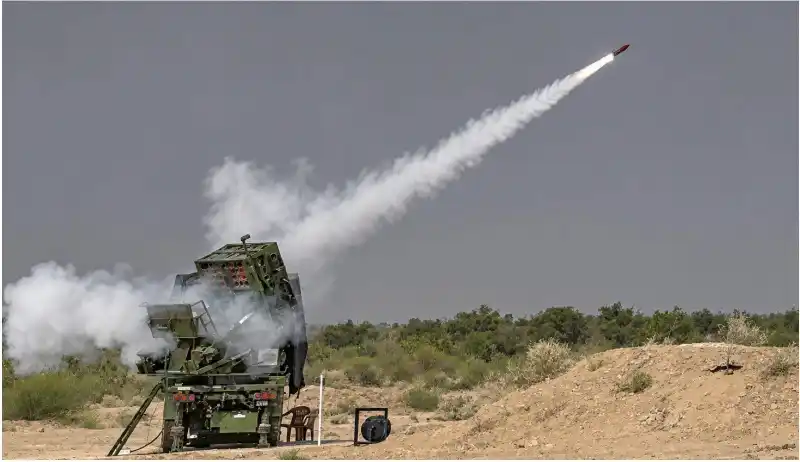
The trials were conducted at the Pokhran Field Firing Ranges in Rajasthan between November 20 and 24, 2026.
Two-Layer Defence Against Drone Swarms
Bhargavastra combines two weapon systems to counter different types of aerial threats. Its first layer uses air defence rockets to engage incoming drones, while the second employs guided micro-missiles equipped with autonomous guidance and infrared seekers for precision interception.
The system is designed to tackle coordinated drone attacks that could overwhelm conventional air defence networks by deploying multiple unmanned aerial vehicles simultaneously.
Rockets and Micro-Missiles Demonstrate Capabilities
During the Pokhran trials, the system’s sensors and command-and-control network detected and tracked actual drone targets. Air defence rockets were fired at the targets, with their warheads successfully hitting designated points.
Separate trials also demonstrated the guidance and terminal homing capabilities of the micro-missiles against drones.
Bhargavastra integrates radio frequency detectors, surveillance radars and electro-optical systems for day-and-night target tracking. An AI-enabled Command, Control, Communications and Intelligence (C4I) network coordinates detection, tracking and weapon engagement.
Moving Towards the Next Stage
The system has been developed under the Ministry of Defence’s Make-II framework, based on the Indian Army’s operational requirements. Its development includes a rocket-based Version I and an advanced Version II featuring guided micro-missiles.
Following the successful development trials, SDAL is preparing the system for a prototype demonstration in its deliverable configuration. Further optimisation and trials are also planned to improve its engagement capabilities.
The development comes amid growing concerns over the use of low-cost drones and coordinated swarm attacks in modern warfare. Indigenous systems such as Bhargavastra could strengthen India’s ability to counter these emerging aerial threats while reducing dependence on imported defence technologies.
