


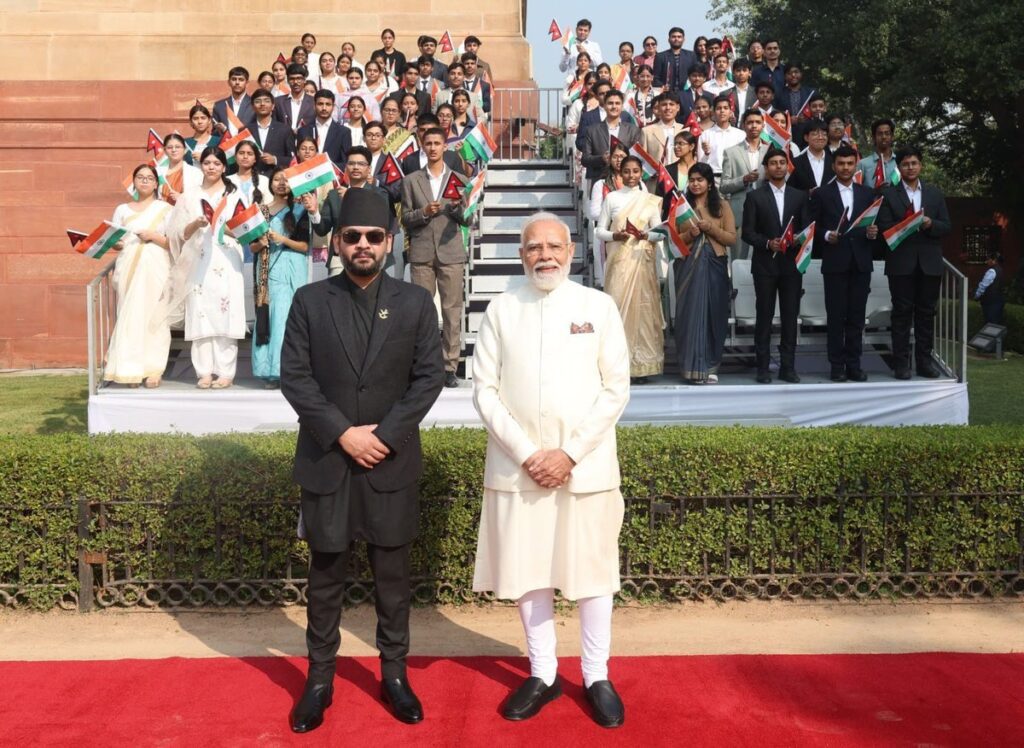
India has announced a development assistance package worth approximately ₹15,000 crore for Nepal following bilateral talks between Prime Minister Narendra Modi and his Nepalese counterpart, Balendra Shah, in New Delhi on November 23, 2026. The announcement marks a significant step towards strengthening cooperation between the two neighbouring countries across energy, infrastructure, education and entrepreneurship.
The package, valued at 24,000 crore Nepali rupees, comprises ₹3,500 crore in grant assistance for post-disaster reconstruction and new infrastructure projects, along with an ₹11,500 crore rupee-denominated Line of Credit for energy-sector projects. The assistance is intended to support Nepal’s recovery following devastating flash floods and help rebuild affected communities and infrastructure.
IIT campus and startup support in Nepal
A major announcement during the talks was India’s plan to establish an offshore campus of an Indian Institute of Technology in Nepal. The initiative will also include a startup incubator and an innovation hub aimed at supporting young entrepreneurs and strengthening the country’s technology and innovation ecosystem.
India will expand scholarship opportunities for Nepali students pursuing higher education in India, particularly in law and technology. The two countries will also work towards developing an agro-industrial park in Nepal to promote food processing and value addition.
The proposed initiatives build on the existing India-Nepal Startup Partnership Network, launched in 2025 in collaboration with IIT Madras and its incubation centre, Pravartak. Its first cohort included 24 Nepali startups selected from around 250 applications.
Energy cooperation and infrastructure projects
The ₹11,500 crore line of credit is earmarked for energy-sector projects. India and Nepal also noted progress towards joint ventures for two cross-border transmission lines: Inaruwa–New Purnea and Dododhara–Bareilly.
The two sides discussed strengthening connectivity through new railway lines, bridges, integrated check posts and petroleum pipelines. They also noted the completion of a field location survey for the proposed Raxaul–Kathmandu electrified broad-gauge railway line and agreed to collaborate on Nepal’s East-West Railway.
Eight agreements and a new train service
India and Nepal exchanged eight memoranda of understanding covering cooperation in space technology, forensic science, policing, civil service training, healthcare, traditional medicine, sustainable urban development, and livestock and fisheries.
The two prime ministers also virtually flagged off the Saryu-Kamala Express, a new weekly passenger train connecting Ayodhya Cantt in Uttar Pradesh with Janakpur Dham in Nepal. Regular commercial services are scheduled to begin on November 28.
Together, the announcements signal a broader effort by India and Nepal to deepen their partnership through development assistance, energy cooperation, education, innovation and cross-border infrastructure.
