


India’s indigenous defence technology ecosystem has marked another development with the successful test-firing of JWALA MK-1, an autonomous counter-drone micro-missile system, at the Pokhran Field Firing Range in Rajasthan. Developed by Indian defence technology company IG Defence, the system is designed to detect, identify, classify and neutralise hostile unmanned aerial vehicles (UAVs).
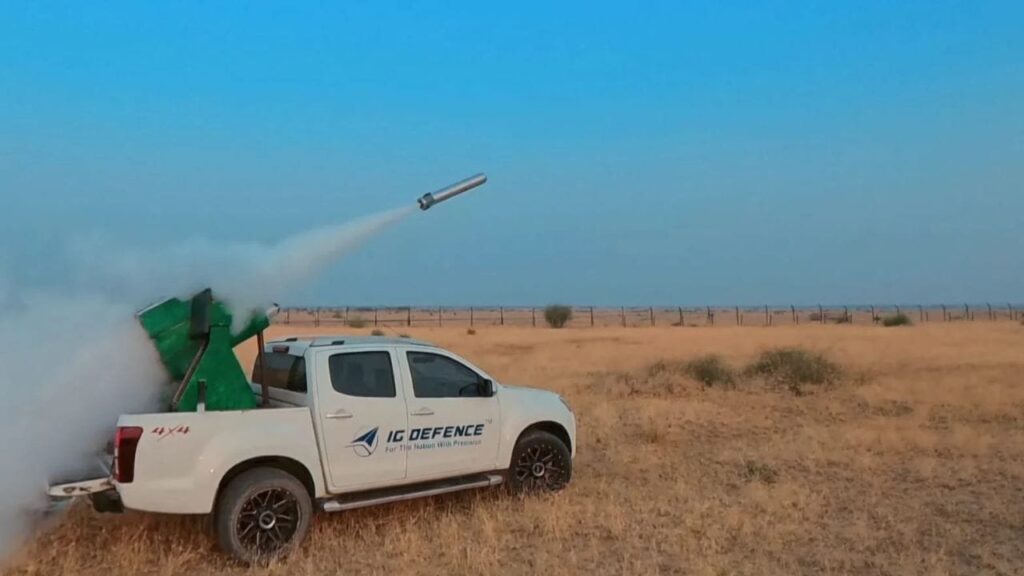
The company describes JWALA MK-1 as India’s first autonomous Counter-Unmanned Aircraft System (CUAS) micro-missile. It has a stated operational range of up to 5 km and offers a hard-kill option, physically destroying hostile drones rather than relying solely on electronic disruption.
AI-powered GRID system
A key feature of JWALA MK-1 is its integration with GRID, IG Defence’s proprietary AI-powered Mission Autonomy and Battle Management System. GRID acts as the intelligence and coordination platform, bringing together sensor inputs, target detection, identification, classification, mission-level decision-making and engagement management.
According to IG Defence founder and CEO Bodhisattwa Sanghapriya, GRID manages the operational chain of JWALA MK-1 by coordinating these functions within a unified architecture. The company’s approach combines indigenous defence hardware with software and autonomous capabilities.
A response to growing drone threats
The increasing use of relatively inexpensive drones for surveillance, reconnaissance and attacks has created new challenges for conventional air-defence systems. Militaries can face a cost imbalance when they have to deploy expensive interceptors against low-cost unmanned platforms.
JWALA MK-1 is being developed as an indigenous and potentially cost-effective option to address this challenge. The Times of India reported that the system is designed to engage drones at distances of 2 to 5 km and altitudes ranging from 50 metres to 5,000 metres.
Part of IG Defence’s counter-drone portfolio
JWALA MK-1 is part of IG Defence’s wider counter-unmanned aerial systems portfolio. The company has also developed T-SHOOL BEAM, an electronic countermeasure-based soft-kill system that aims to disrupt or disable hostile drones.
While electronic countermeasures provide a soft-kill response, JWALA MK-1 offers a kinetic interception option. Together, these technologies could support a layered approach to counter-drone operations.
The Pokhran test marks a development milestone for JWALA MK-1. Further trials, technical evaluations and operational assessments will be necessary to establish its performance and readiness for deployment.
