


Prime Minister Narendra Modi inaugurated COSMOS-Mysuru Planetarium in Karnataka on November 13, marking a major milestone in India’s astronomy education and science outreach initiatives. Developed by the Indian Institute of Astrophysics (IIA) in collaboration with the University of Mysore, the facility is India’s first LED dome planetarium and features an immersive display with resolution exceeding 8K.
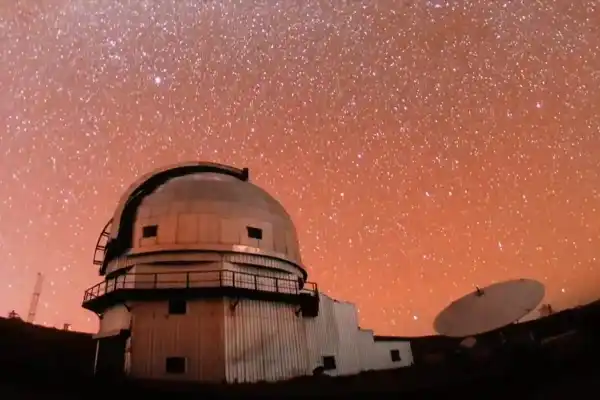
Located at the foothills of Chamundi Hills on the University of Mysore campus, COSMOS-Mysuru is designed to help students, researchers and the public explore the universe through advanced visual technology.
15-Metre Dome with 4.2 Crore Pixels
The planetarium’s main attraction is a 15-metre tilted LED dome featuring approximately 6,150 individually controlled LED panels and 4.2 crore pixels.
Unlike conventional planetariums that use projectors to display images on a passive dome, the LED technology allows the entire dome to function as a high-resolution display. It produces detailed visuals of stars, planets, galaxies and other astronomical phenomena.
The Sky Theatre can accommodate around 160 visitors. It will screen professionally produced astronomy programmes as well as an in-house film exploring the relationship between Mysuru’s history and astronomy. Shows will be available in Kannada, English and Hindi.
Three Years of Astronomy Outreach
COSMOS-Mysuru is also the outcome of a three-year astronomy education and outreach programme conducted by the Indian Institute of Astrophysics across Mysuru city and surrounding rural areas.
During this period, the institute organised more than 150 events, reaching over 40,000 participants. These included school activities, student and teacher workshops, public lectures, technical discussions and online sessions in Kannada and English.
The initiative aimed to build awareness of astronomy and prepare local communities to benefit from the new facility.
Beyond Planetarium Shows
The institute plans to use COSMOS-Mysuru as a centre for academic training, research and scientific learning. Future programmes will include workshops, data-analysis sessions and activities that use the LED dome to help students understand astronomical observations and scientific concepts.
The inauguration also reflects India’s broader efforts to strengthen its scientific research ecosystem and encourage young people to pursue science and technology.
Speaking at the event, Modi highlighted India’s achievements in astronomy and space exploration, including Chandrayaan-3, Aditya-L1 and space docking. He also emphasised the importance of making advanced scientific facilities accessible to students.
With its advanced display technology and expanding education programmes, COSMOS-Mysuru is expected to strengthen astronomy awareness and scientific engagement among young learners and the wider public.
