


Prime Minister Narendra Modi has called for greater use of rooftop solar power in Indian households, including for cooking and charging electric vehicles, as part of efforts to reduce the country’s dependence on imported energy.
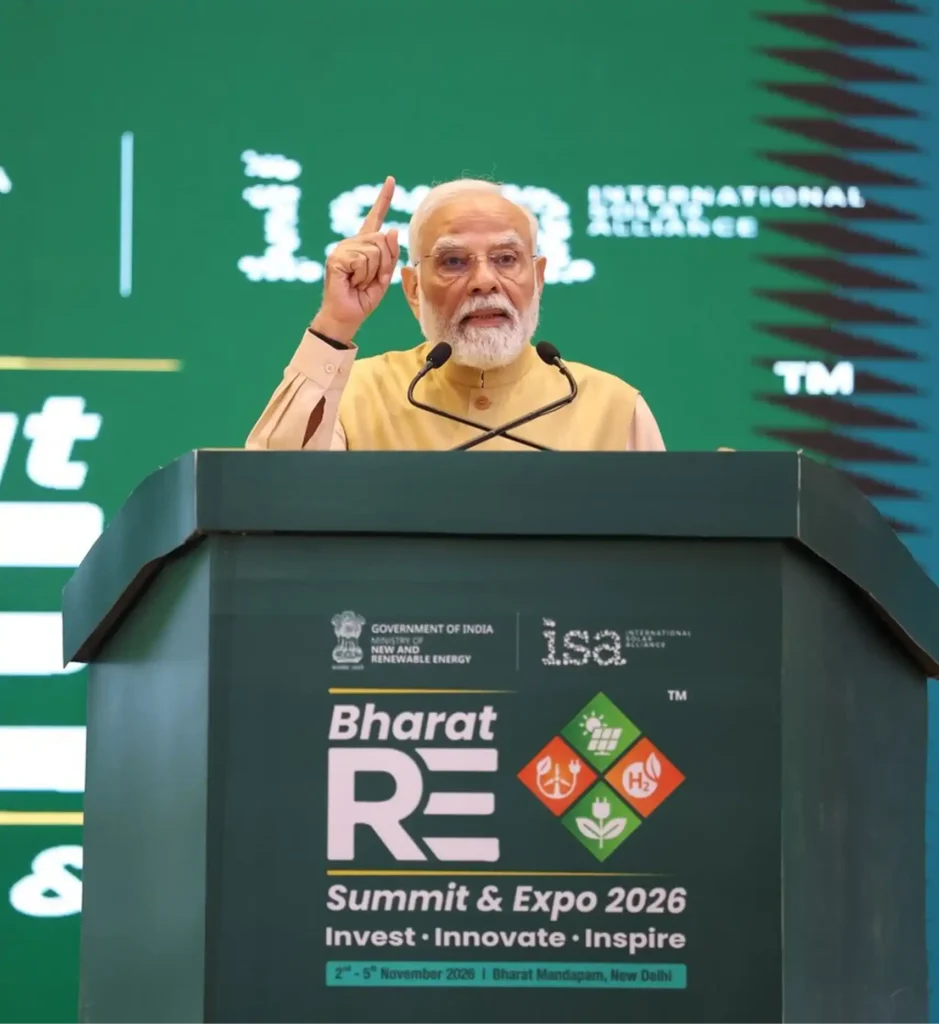
Speaking at the Bharat Renewable Energy Summit and Expo 2026 in New Delhi on November 2, Modi urged startups, IITs, innovators and entrepreneurs to develop solar-based solutions that can meet household energy requirements throughout the day and across seasons.
He proposed a Clean Cooking Movement that would enable families to prepare food using electricity generated by solar panels installed on their rooftops. The move, he said, could reduce dependence on imported cooking gas and help households save on energy expenses.
The Prime Minister also encouraged families to use rooftop solar power to charge electric two-wheelers and cars at home. Such arrangements could help middle-class households save thousands of rupees annually while supporting India’s transition to cleaner transport.
Energy Security Linked to Clean Energy
Modi said the West Asia crisis had underlined the direct connection between energy security and economic security. He noted that investments in clean energy over the past decade had helped India manage global energy disruptions.
He announced India’s ambition to add another 500 GW of non-fossil fuel-based power capacity over the next 10 to 11 years. The country has already achieved nearly 300 GW of non-fossil installed capacity, accounting for more than half of its total installed power capacity.
Rooftop Solar Adoption Expands
Highlighting the progress of the PM Surya Ghar Muft Bijli Yojana, Modi said more than 65 lakh households had joined the rooftop solar programme. Launched in February 2024, the scheme aims to bring rooftop solar installations to one crore homes.
He also cited the PM-KUSUM scheme, which has supported solar-powered irrigation for more than 30 lakh farmers. The Prime Minister called for expanding solar adoption in agriculture, including installing panels on unused farmland and along field boundaries.
Focus on Innovation and Domestic Manufacturing
Modi stressed the need for indigenous energy storage technologies and additional battery storage capacity to support the expansion of renewable power. He urged researchers, investors and startups to develop solutions that can make solar energy more reliable and accessible.



He also highlighted India’s growing solar manufacturing capacity. Solar module manufacturing capacity has increased from around 2 GW a decade ago to more than 200 GW, while solar cell manufacturing capacity has reached nearly 40 GW.
The Prime Minister said the renewable energy sector had attracted investments of more than ₹15 lakh crore over the past decade. He added that investment opportunities in the sector could exceed ₹20 lakh crore by the end of the decade.
The push for rooftop solar, clean cooking and solar-powered mobility reflects the government’s broader effort to make renewable energy part of everyday household life while strengthening India’s energy security.
