


IIT Madras-incubated The ePlane Company is developing a flying taxi with seven layers of safety designed to reduce the risks associated with electric vertical take-off and landing aircraft. Its e200X prototype combines multiple motors, backup battery systems, alternative flight modes and emergency landing mechanisms.
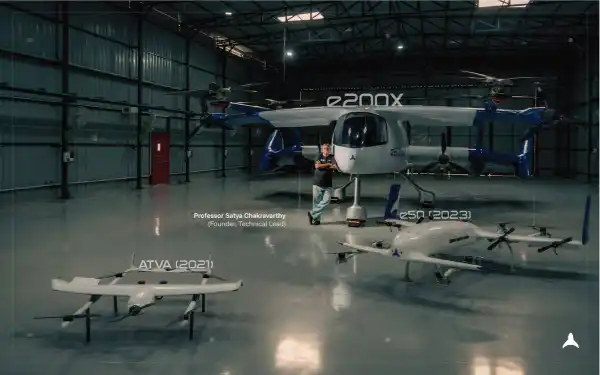
Founded by IIT Madras professor Satya Chakravarthy, the Chennai-based company aims to introduce the aircraft as an electric air ambulance before expanding into urban passenger transport. The company is targeting commercial deployment in 2028, subject to testing and regulatory certification.
Seven Layers of Safety in the e200X
The e200X uses 10 propellers arranged in a lift-plus-cruise configuration. Six vertical rotors provide lift during take-off and landing, while four additional propellers propel the aircraft forward.
According to Chakravarthy, the aircraft incorporates seven layers of safety designed to provide backup options if individual components or systems fail.
The first layer focuses on the electrical powertrain. Each motor has dual windings and two controllers, while multiple battery packs provide alternative power sources. This arrangement is designed to reduce dependence on any single electrical component.
The second layer involves rotor redundancy. If one of the six lifting rotors fails, the remaining rotors are designed to continue providing lift. Similarly, the aircraft has multiple forward propellers to help maintain propulsion if one fails.
Alternative Flight Modes and Emergency Landing Systems
The third layer addresses the possibility of multiple rotor failures. The company says the aircraft can switch flight modes to use wing-generated lift when the vertical lifting system encounters problems. If forward propellers fail, the vertical rotors can help maintain lift while the aircraft prepares for an emergency landing.
The fourth layer is the aircraft’s ability to glide. The company says the e200X has a glide ratio of approximately 10:1, meaning it can theoretically travel around 10 metres forward for every metre of altitude lost under suitable conditions.
The fifth layer includes parachutes and inflatable systems intended to reduce the impact of an emergency descent. The sixth involves a reinforced airframe designed to withstand specified impact conditions.
The seventh layer consists of an energy-absorbing cushion beneath the passenger seat. The aircraft also incorporates four-point seat harnesses and energy-absorbing seat structures to help protect occupants during a hard landing.
Safety Claims Still Need to Be Validated
Although the company has outlined multiple safety mechanisms, their combined effectiveness must be established through testing and certification. Chakravarthy told India Today that the probability of failures across the different safety layers had not yet been fully quantified.
The aircraft has not yet been certified to carry passengers. The company must demonstrate that the aircraft meets the Directorate General of Civil Aviation’s requirements before commercial operations can begin.
Testing will also need to address operating conditions such as rain, dust, lightning and bird strikes. These factors are particularly important for aircraft intended to operate in dense urban environments.
Why ePlane Is Targeting Air Ambulances First
Rather than launching directly into the competitive passenger air taxi market, ePlane plans to introduce the e200X for emergency medical transport.
An electric air ambulance could help move patients between hospitals or across congested urban areas without relying entirely on road transport. The aircraft is designed to accommodate a pilot and two additional occupants, depending on the configuration.
The company has previously outlined a targeted range of around 110 km and an ideal cruising speed of approximately 160 kmph. These are development targets and will need to be demonstrated and confirmed through testing and certification.
Starting with medical transport could also allow the company to serve specialised customers before scaling up to broader passenger services. Hospitals and emergency service providers could become early users if the aircraft meets safety, operational and commercial requirements.
Noida Airport Partnership Supports Flying Taxi Infrastructure
The ePlane Company has also signed a memorandum of understanding with Noida International Airport to develop the infrastructure needed for future electric aircraft operations.
The proposed collaboration covers vertiports, charging stations, operating procedures and coordination with aviation regulators. The partners also plan to explore airport-to-airport transport, intra-city travel and emergency air ambulance services.
The agreement is intended to ensure that ground infrastructure and operational systems develop alongside the aircraft. However, the partnership does not itself constitute regulatory approval for commercial flights.
India’s Electric Air Mobility Ambitions
The e200X is part of India’s broader effort to develop indigenous aerospace technology and new urban transport systems. Electric vertical take-off and landing aircraft could eventually support medical emergencies, short-distance passenger travel and specialised transport services.
However, commercial success will depend on more than aircraft design. Certification, infrastructure, charging facilities, pilot training, maintenance and operating costs will all influence adoption.
For ePlane, the immediate priority is to demonstrate that its safety systems work reliably under real operating conditions. If the aircraft secures certification and meets its development targets, the company hopes to establish electric air ambulances as an early application before moving towards wider flying taxi services.
