


Prime Minister Narendra Modi on Wednesday marked 25 years of uninterrupted service as the head of a government, completing a political journey that began as Gujarat Chief Minister in 2001 and later took him to the Prime Minister’s Office.
Modi assumed office as Gujarat Chief Minister on October 7, 2001. After more than 12 years in the state, he became the BJP’s prime ministerial candidate and led the party to a majority in the 2014 Lok Sabha elections. He went on to secure successive terms in 2019 and 2024, becoming the first prime minister after Jawaharlal Nehru to lead a government for three consecutive terms.
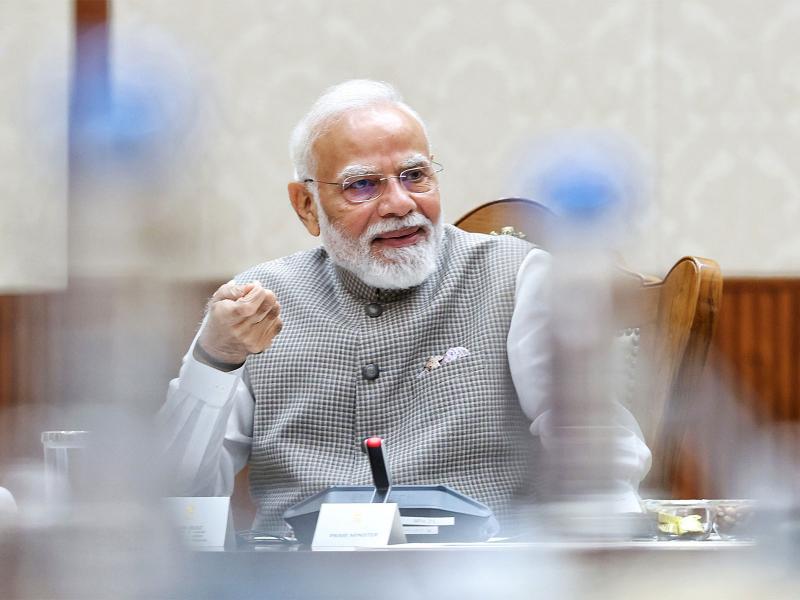
On the milestone day, Modi offered prayers and performed aarti at Shri Vinayak Mandir in Sarojini Nagar, Delhi. He prayed for the well-being of the country’s 140 crore people and reiterated his commitment to serving the nation with dedication.
Vice President CP Radhakrishnan congratulated Modi on completing 25 years as head of government. In a post on X, he described Modi’s journey as one that had transformed the idea of inclusive development into a nationwide mission under the principles of Sabka Saath, Sabka Vikas, Sabka Vishwas and Sabka Prayaas.
Radhakrishnan also highlighted the government’s claim that 25 crore people had moved out of extreme poverty over the past 15 years. He said improvements in connectivity, digital infrastructure, economic opportunities and inclusive development had contributed to India’s transformation.
From Gujarat to the Centre
Modi’s first experience at the head of a government came in Gujarat in 2001. During his tenure, the state witnessed several major infrastructure and development initiatives.
The Kutch region was rebuilt following the devastating 2001 earthquake, while Gujarat introduced a state disaster management law in 2003. The Vibrant Gujarat Summit was launched the same year to attract investment and showcase the state’s economic potential.
The Jyotigram Yojana, launched in 2006, focused on providing reliable three-phase electricity to villages. The government also introduced the Sagarkhedu Sarvangi Vikas Yojana to support coastal communities through infrastructure, irrigation, fisheries, livelihoods and coastal development.
The Garib Kalyan Mela was launched in 2009 to improve the delivery of welfare benefits. Water management projects, including check dams, farm ponds, recharge wells and canals, were also expanded, while infrastructure development connected ports with roads, railways, power facilities and industrial estates.
In 2013, the BJP appointed Modi as the party’s campaign committee chief for the 2014 elections and subsequently named him its prime ministerial candidate. The BJP won 282 Lok Sabha seats in 2014, securing its first single-party majority since 1984.
First Term as Prime Minister
During Modi’s first term from 2014 to 2019, the government launched several major welfare and economic programmes.
The Pradhan Mantri Jan Dhan Yojana expanded access to banking, with millions of accounts opened for people who had previously remained outside the formal financial system. The initiative later became a key part of the government’s direct benefit transfer system.
The Swachh Bharat Mission was launched after Modi highlighted the lack of sanitation facilities and their impact on women. The Pradhan Mantri Ujjwala Yojana, introduced in 2016, provided LPG connections to women from poor households.
The government also expanded social security and healthcare coverage through programmes such as Ayushman Bharat. Another major reform was the introduction of the Goods and Services Tax in 2017, which brought multiple indirect taxes under a unified framework.
Second Term and Major Policy Decisions
During Modi’s second term from 2019 to 2024, the government took several major political and constitutional decisions.
In 2019, the special constitutional status of Jammu and Kashmir under Article 370 was revoked, and the former state was reorganised into the Union Territories of Jammu and Kashmir and Ladakh.
The Supreme Court’s Ayodhya verdict paved the way for the construction of the Ram Mandir, with the consecration ceremony held in January 2024. The Citizenship Amendment Act was also passed in 2019, providing a pathway to citizenship for specified persecuted non-Muslim communities from Pakistan, Bangladesh and Afghanistan.
The COVID-19 pandemic presented a major challenge during the second term. India expanded domestic vaccine production and conducted one of the world’s largest vaccination drives. The government also promoted the Atmanirbhar Bharat programme, while digital payments through UPI expanded rapidly.
Third Term and Focus on Self-Reliance
The BJP entered the 2024 Lok Sabha elections seeking a larger mandate but lost its single-party majority. However, the BJP-led NDA secured enough seats to form the government, allowing Modi to begin his third consecutive term as Prime Minister.
His third-term agenda has continued to focus on manufacturing, semiconductor production, startups, digital infrastructure and self-reliance.
BJP Marks the Milestone
The BJP has turned Modi’s 25 years at the helm of government into a nationwide campaign through the month-long Seva Sankalp Abhiyan, which began on his 76th birthday on September 17.
The campaign includes blood donation drives, cleanliness programmes, welfare outreach, exhibitions, cultural events, rallies and other public-service activities. The concluding programmes are being held in Gujarat’s Vadnagar, Modi’s birthplace, and Varanasi, his parliamentary constituency.
In Varanasi, participants are scheduled to conclude their journey with Jalabhishek at the Kashi Vishwanath Dham, while the Vadnagar programme will conclude at the historic Hatkeshwar Mahadev Mandir.
Events are also being held across states, with BJP workers participating in torch marches, motorcycle and cycle rallies and exhibitions highlighting Modi’s political journey.
Cabinet Praises 25 Years of Leadership
The Union Cabinet formally congratulated Modi on Tuesday for completing 25 years of continuous leadership as head of government.
Information and Broadcasting Minister Ashwini Vaishnaw said the Cabinet resolution highlighted the principle of Nation First and Citizen First as a key theme of Modi’s governance.
The resolution cited welfare programmes, infrastructure expansion, economic reforms and technological development. It highlighted Jan Dhan accounts, housing schemes, PM-KISAN transfers, GST, digital payments and UPI as major initiatives.
The government also pointed to the expansion of highways and railway electrification, growth in electronics and defence manufacturing and the development of India’s semiconductor industry.
Technological achievements such as the domestic production of COVID-19 vaccines and the Chandrayaan-3 lunar landing were also cited as examples of India’s growing capabilities.
Security and Global Role
The Cabinet resolution also highlighted national security initiatives, including the 2016 surgical strikes, the 2019 Balakot air strikes and Operation Sindoor in 2025.
The government cited the removal of Article 370, One Rank One Pension, the creation of the Chief of Defence Staff and efforts to tackle Maoist violence among key security-related measures.
On foreign policy, the resolution highlighted India’s role in the G20 and BRICS, its engagement with the Global South, the inclusion of the African Union in the G20 and the Vaccine Maitri initiative.
It also noted that Modi has received state honours from 36 countries.
As the BJP marks 25 years of Modi’s leadership at the head of government, the party is presenting his political journey from Gujarat to New Delhi as part of its broader vision of building a developed India by 2047.
