


Russia’s state-owned nuclear energy company Rosatom is in discussions with some of India’s major private and government-owned companies about participating in the country’s growing nuclear power sector.
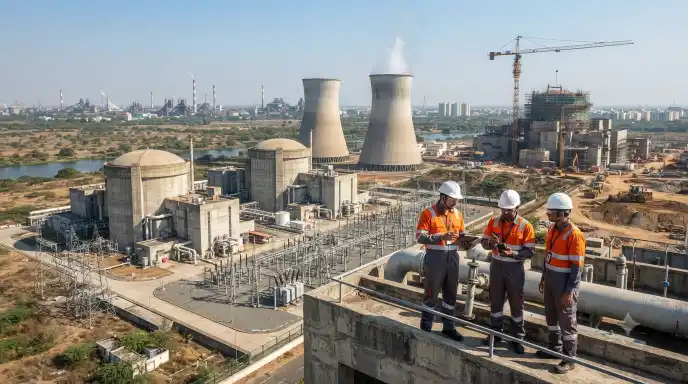
The companies include Adani Group, Reliance, Jindal and state-owned power producer NTPC. Kirill Komarov, First Deputy Director General for Corporate Development and International Business at Rosatom, said the talks are focused on exploring opportunities to bring nuclear technologies and investment into India.
The discussions come after India opened its nuclear power sector to greater private participation through the Sustainable Harnessing and Advancement of Nuclear Energy for Transforming India (SHANTI) Act, 2025.
India aims to increase its nuclear power capacity from the current 8.78 GW to 100 GW by 2047.
More Companies Needed
Komarov said Rosatom is speaking with several major Indian companies that are interested in gaining access to nuclear technology.
He said greater private participation could help India bring more companies into the sector and increase investment in nuclear power projects alongside government-owned companies.
India is looking to expand nuclear power as a reliable source of electricity that can provide power around the clock. Nuclear energy can also support growing electricity demand from data centres, advanced industries and emerging technologies.
At present, nuclear power accounts for only about 1.6 per cent of India’s total installed electricity capacity of 556.85 GW. Coal makes up around 45.35 per cent, while renewable energy accounts for about 43 per cent.
Rosatom Sees Opportunity in India
Rosatom is one of the world’s largest integrated nuclear energy companies and is a major player in the global nuclear power industry.
The company currently has 46 nuclear power units at different stages of construction and implementation across 10 countries, including India, China, Bangladesh, Türkiye, Egypt, Hungary, Iran and Kazakhstan.
Russia’s nuclear technology company is also looking beyond simply supplying reactors to India. Komarov said developing local manufacturing capabilities will be an important part of the country’s nuclear expansion.
Focus on Make in India
Komarov said India cannot depend heavily on imported equipment and materials if it wants to achieve such a large increase in nuclear capacity.
He highlighted the importance of the Make in India approach, with more equipment, components and materials being produced within the country.
According to Komarov, Rosatom has already achieved around 50 per cent localisation at the Kudankulam nuclear power project in Tamil Nadu. The company is prepared to work with more Indian companies and replicate this model as the country expands its nuclear programme.
Private Participation Could Increase Capacity
Komarov said the scale of India’s 100 GW nuclear target would be difficult for a single organisation such as the Nuclear Power Corporation of India (NPCIL) to achieve on its own.
He said involving private companies could bring more investment, resources and construction capacity into the sector. More companies could take part in building, operating and investing in nuclear power projects.
Rosatom’s Global Experience
Rosatom has operations across several areas of the nuclear energy industry, including reactor construction, nuclear fuel, uranium mining and the wider nuclear fuel cycle.
Komarov said Russia has extensive experience in exporting nuclear technology and services. Of the 32 nuclear units Rosatom is currently constructing for export around the world, 28 are based on Russian designs.
The company has also built around 20 nuclear power plants over the past two decades, strengthening its position as a major global nuclear technology provider.
