


Union Minister Nitin Gadkari has called on sugar mills to reduce their dependence on sugar production and expand into ethanol, compressed biogas (CBG) and other value-added products to improve earnings and support farmers.
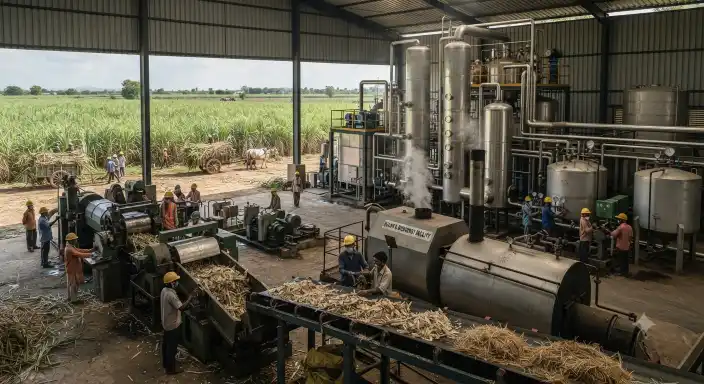
Speaking at the National Federation of Cooperative Sugar Factories Ltd efficiency awards, Gadkari said sugar mills cannot rely only on sugar revenue because global production and price changes can have a direct impact on the industry.
He said diversification into energy and power could make agriculture more economically viable. According to Gadkari, agricultural waste such as bagasse, paddy straw, bamboo and Napier grass can be converted into fuels and other useful products under a waste-to-wealth approach.
Ethanol, he said, offers a major opportunity for sugar mills, with sugarcane juice and other agricultural feedstocks being used for production. Integrated sugar complexes and distilleries can also generate additional income from processing by-products.
Gadkari also highlighted compressed biogas as another growth area. He said CBG can be produced from paddy straw, bagasse, bamboo and Napier grass. Government data cited by him showed that 1,908 CBG plants have been registered in India, with 132 currently operational.
He pointed to the large amount of crop residue being burnt in Punjab and Haryana, saying this waste could instead be converted into biofuels. Such a shift could help reduce pollution, lower fossil-fuel imports and create additional income for farmers.
The minister also highlighted India’s progress in sustainable aviation fuel and advanced biofuels, including an Indian Oil SAF plant in Panipat and bamboo-based ethanol production at Numaligarh in Assam.
Gadkari said sugar mills could also earn more from by-products such as press mud and wax. He cited sugar mills in Satara where sugarcane-derived wax is sold at around ₹300-350 per kg for use in the cosmetics industry.
He also pointed to the growing use of flex-fuel vehicles and said Toyota is expected to launch a 100% ethanol-compatible Innova. Greater use of electric vehicles to transport sugarcane from farms to mills could also help reduce diesel costs.
According to Gadkari, technologies such as artificial intelligence, nano urea, nano DAP and drone-based farming could help reduce agricultural costs and improve productivity.
He further highlighted the potential of converting carbon dioxide into products such as hydrogen, methanol and urea using newer technologies.
Gadkari said the growth of maize-based ethanol production has already increased demand for maize, with prices in Bihar and Uttar Pradesh rising from around ₹1,800 to ₹2,600 per quintal. He estimated that this had put an additional ₹45,000 crore into farmers’ hands.
The minister said ethanol production from damaged grain and broken rice is also creating new markets for agricultural produce. He stressed that farmers should increasingly be able to earn from energy and value-added products rather than depending only on traditional commodities.
Gadkari said knowledge-to-wealth and waste-to-wealth should become key principles for India’s agriculture and rural economy, with technology, innovation, entrepreneurship and skill development playing a major role in improving farm incomes and creating rural jobs.
