


Cybersecurity is no longer a concern limited to technology experts or security professionals. According to Air Commodore Prasanth Balakrishnan Nair, Indian astronaut and ISRO official, it has become a responsibility shared by every citizen in an increasingly digital world.
Speaking about the Kerala Cyber Suraksha Summit (KCSS), Prasanth Nair said the growing dependence on smartphones, the internet, digital payments and online services makes cybersecurity an unavoidable part of everyday life. He stressed that awareness is the most important first step towards building a cyber-resilient India.
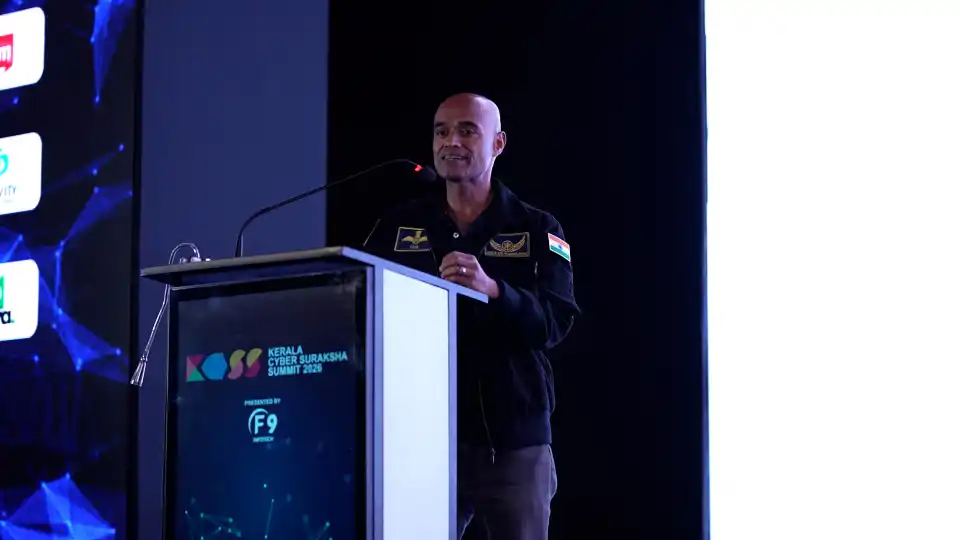
While technical and operational cybersecurity require specialised expertise, Nair said India also needs to look at the issue from a strategic perspective. He described AI as a potential “weapon of the future” and argued that India must develop and retain greater sovereign control over artificial intelligence technologies.
His concern extends beyond individual cyberattacks to vulnerabilities between nations. As digital connectivity increasingly crosses geographical boundaries, he said countries must consider whether dependence on foreign AI and digital infrastructure could create strategic vulnerabilities during periods of conflict or geopolitical tension.
Nair called for a whole-of-nation approach to cybersecurity, saying the responsibility cannot be confined to a single sector or institution. Digital resilience, he suggested, must become part of India’s broader national strategy.
India Must Be Ahead of the Game
Reflecting on India’s ability to adapt through history, Nair said the country now faces a new technological era in which traditional boundaries have been significantly reduced.
He compared the transformative nature of the internet to space, where geographical boundaries do not operate in the conventional sense. For India, he said, this creates a need to stay ahead rather than simply adapt after technologies become established elsewhere.
His message to Indians was centred on confidence. He urged people not to underestimate their capabilities and argued that India should reclaim its rightful position among the world’s leading powers by developing solutions based on its own strengths.
A Different Approach to Leadership
Asked how he handles the expectations associated with his role and spaceflight, Nair spoke about staying focused on the present rather than being driven by fear of missing out.
He said his personal philosophy is to feel “complete right here, right now”, viewing everything else as a bonus. He connected this idea to the pressures created by social media, where people can constantly be made to feel that they are missing something.
For young Indians dreaming about space and ambitious careers, his message was one of awareness, gratitude and confidence.
Science and Spirituality Are Not Opposites
Nair also reflected on the relationship between science and spirituality, arguing that the two should not necessarily be viewed as separate worlds.
Drawing on the concept of Ardhanarishvara and the idea of yin and yang, he said seemingly opposite elements can exist as parts of a whole. He similarly described science and art as interconnected, pointing to India’s classical performing arts as examples of creativity shaped by underlying processes and discipline.
According to Nair, great scientists often bring creativity into their scientific work, while great artists incorporate structure and processes into their art. Bringing both dimensions together, he said, can help individuals become more complete.
Solve India’s Problems First
For India’s startup ecosystem, Nair had a clear message: look inward and solve problems that genuinely affect Indian communities.
He cautioned against automatically adopting problems identified elsewhere as universal problems. Instead, entrepreneurs should examine pain points in their own villages, communities, states and society and build solutions around those needs.
He also urged Indians to develop greater confidence in the country’s capabilities, pointing to India’s contributions to the world as evidence of its potential.
Teamwork Over Competition
For team leaders, Nair used a simple analogy: the right hand does not expect the left hand to return a favour before helping it.
The message, he said, is that members of an organisation should recognise that they are part of the same body. Teams cannot function effectively when individuals work in isolation.
He advocated positive competition rather than negative competition, combined with awareness that everyone contributes to the same larger mission.
For Nair, whether the challenge is cybersecurity, space exploration, entrepreneurship or nation-building, the underlying principle remains the same: awareness, confidence, collaboration and the willingness to think beyond conventional boundaries.
