


Ravi Tamta, a Bachelor of Arts graduate from Uttarakhand’s Almora district, has developed an electric flying vehicle prototype without formal engineering education. After 13 years of independent learning and experimentation, his single-seater vehicle, HAPIDA SKYNeX, completed a test flight in August 2026.
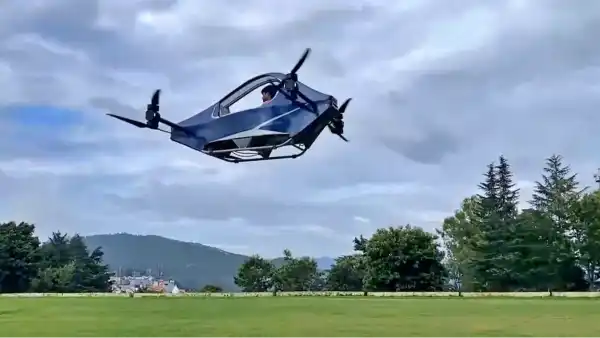
The project reflects Tamta’s effort to explore alternative transport for hilly regions, where winding roads can make journeys to essential services, including hospitals, long and difficult.
From a Mountain Village to a Flying Vehicle
Tamta grew up in Kaflikhan village near Jageshwar Dham in Uttarakhand. The challenges of travelling across mountainous terrain inspired his interest in personal air mobility. He began pursuing the flying vehicle idea in 2015 through his venture, Hapida Sky Private Limited.
Without formal training in science or engineering, Tamta relied on online resources, repeated experiments and family support to develop his technical knowledge.
How HAPIDA SKYNeX Works
The prototype is designed for vertical take-off and landing, meaning it does not require a conventional runway. It uses multiple electric motors and propellers, applying technology similar to that used in multirotor drones.
The vehicle features a lightweight frame, a cockpit designed for one person and a transparent canopy. It is battery-powered and does not rely on conventional aviation fuel.
A Test Flight, Not Yet Commercial Readiness
The successful test flight marks an important development milestone, but the prototype is still at an early stage. Further trials will be needed to evaluate its flight stability, battery performance, structural strength and safety systems. Regulatory approvals will also be required before it can be used operationally.
If developed and approved for practical use, electric flying vehicles could eventually support short-distance travel in remote areas, including potential medical and emergency applications. However, these uses remain possibilities rather than established capabilities of the current prototype.
Other Practical Inventions
HAPIDA SKYNeX is not Tamta’s first invention. His earlier projects reportedly include mobile phone-charging shoes, a smart walking stick for people with visual impairments, a bamboo-splitting machine and firefighting equipment.
His journey highlights how online learning and hands-on experimentation can help people explore technical ideas beyond conventional education pathways. It also underlines the importance of rigorous engineering tests and safety approvals when turning an innovative concept into a vehicle designed to carry a person.
