


What began as an engineering project at IIT Madras has evolved into a technology venture focused on making sanitation work safer in India.
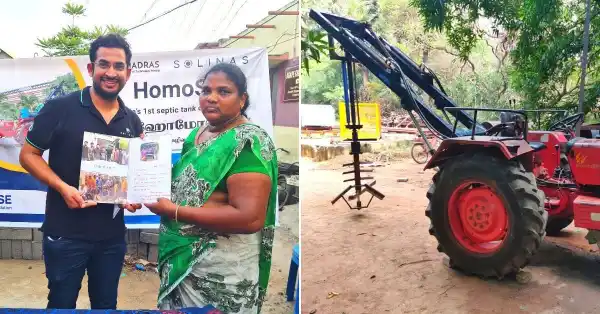
Divanshu Kumar, an engineer from Gaya in Bihar, developed HomoSEP, a robotic system designed to clean septic tanks and remove sewage without requiring sanitation workers to enter hazardous underground spaces.
From IIT Madras Project to Real World Technology
Kumar studied Mechanical Engineering at IIT Madras between 2014 and 2019 before pursuing a master’s degree in Product Design. During his postgraduate studies, he worked on a project focused on septic-tank cleaning.
The project introduced him to the potential of robotics in reducing the risks faced by sanitation workers involved in manual cleaning. Developed under Professor Prabhu Rajagopal, the technology was later showcased at the IIT Madras Carbon Zero Challenge in 2019.
The academic project eventually moved beyond the laboratory and became part of Solinas Integrity, an IIT Madras-incubated startup co-founded by Kumar, who now serves as its CEO.
HomoSEP Earns National Recognition
HomoSEP received recognition at IIT Madras after Kumar won the Bhagyalakshmi and Krishna Ayengar Prize for the best master’s project in sanitation.
The award was presented by Prime Minister Narendra Modi, making Kumar a Prime Minister awardee.
The recognition came as the team was exploring ways to turn the prototype into a practical solution for sanitation workers. Instead of limiting the technology to research, Kumar and his colleagues began working on its deployment in environments where manual sanitation can pose serious health and safety risks.
This effort eventually contributed to the formation of Solinas Integrity, which focuses on robotics and artificial intelligence for water and sanitation infrastructure.
Kumar’s work also received wider recognition in 2025 when he was included in the Forbes India 30 Under 30 list in the Industry and Manufacturing category.
How the HomoSEP Robot Works
HomoSEP is designed to clean septic tanks and manholes while keeping sanitation workers outside the hazardous area.
The robot uses a combination of mechanical equipment and suction technology to remove accumulated sewage sludge.
- A rotary blade breaks down hardened sludge inside septic tanks.
- The loosened material is converted into slurry and removed using a suction system.
- Operators can control the machine without entering the tank.
- The system aims to reduce the need for manual entry into sewage-filled spaces.
The technology is designed to address one of the most dangerous aspects of sanitation work while improving the efficiency of septic-tank cleaning.
Solinas Expands Beyond Septic Tanks
Solinas Integrity has expanded its technology portfolio beyond HomoSEP.
Its Endobot system is designed to inspect water and sewer pipelines, including narrow sections that are difficult to access and examine manually.
The company also uses artificial intelligence for infrastructure data management through its Swasth AI platform.
Together, these technologies focus on essential water and sanitation infrastructure that often requires difficult, hazardous or inaccessible maintenance work.
From College Innovation to Startup
Solinas has moved from developing prototypes towards field deployment of its robotic solutions. IIT Madras has also highlighted plans to deploy multiple HomoSEP units, with sanitation workers and self-help groups affected by manual scavenging being part of the initiative.
The startup has attracted investment and works with government agencies, civic organisations and private companies. Forbes India has reported that Solinas raised $5 million and was targeting revenue of Rs 15 crore for FY25.
For Kumar, entrepreneurship started even before the development of HomoSEP. During his sophomore year at IIT Madras, he co-founded Involve, a social enterprise focused on peer-based learning in schools.
The venture aimed to encourage students to take an active role in learning through peer teaching and mentoring.
His early entrepreneurial experience and later work in sanitation reflect a similar approach of using technology to address real-world challenges.
Kumar’s journey demonstrates how an academic project can evolve into a commercial technology venture while addressing one of the most difficult and hazardous challenges faced by sanitation workers in India.
