


During the Cold War, the Soviet MiG-21 became one of the world’s most famous supersonic fighter jets. India and China, however, used the aircraft in very different ways.
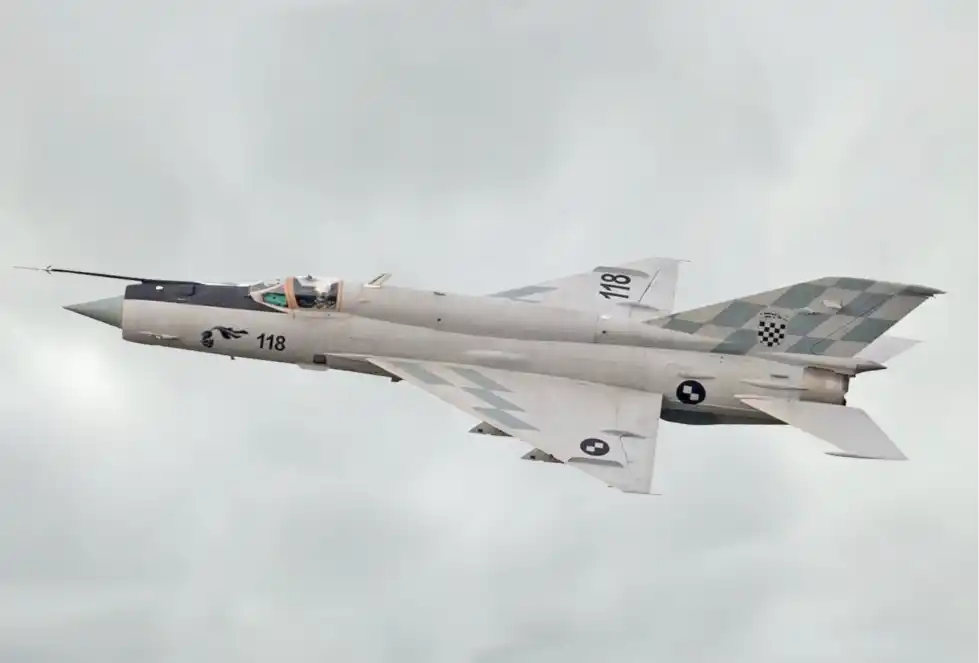
India chose to build the MiG-21 under licence through Hindustan Aeronautics Limited (HAL). China initially received the aircraft and technical support from the Soviet Union but later developed its own version, known as the J-7.
India Built the MiG-21 Under Licence
India selected the MiG-21 in 1962 to modernise its air force. Under an agreement with the Soviet Union, HAL began producing the fighter in India.
India eventually built more than 800 MiG-21 aircraft, including several variants.
Since India had access to Soviet designs, technology and technical support, Indian engineers did not have to reverse-engineer the aircraft. Instead, the focus was on building the factories, skills and systems needed to manufacture advanced fighter jets in India.
China Developed the J-7
China also received MiG-21 aircraft from the Soviet Union. But the Sino-Soviet split in the 1960s ended technical cooperation.
Chinese engineers were left with limited technical information and had to continue the programme largely on their own. Their efforts led to the development of the J-7, a Chinese version of the MiG-21.
China continued improving the J-7 for decades. Engineers added better engines, radar, weapons and other systems.
The aircraft was later exported as the F-7 to countries including Pakistan and Bangladesh.
Different Paths
India continued receiving newer Soviet aircraft, including the MiG-23, MiG-27 and MiG-29, and later the Su-30MKI. This reduced the need to develop many local versions of the MiG-21.
China, on the other hand, kept developing the J-7. This gave generations of Chinese engineers experience in aircraft design, engines, radar and weapons.
India Took the Harder Route to Indigenous Design
India eventually began developing its own fighter aircraft through projects such as the HF-24 Marut and the Light Combat Aircraft programme, which produced the Tejas.
Building a fighter from scratch was much more difficult than upgrading an existing aircraft.
China’s long development of the J-7 gave its engineers a gradual path toward more advanced indigenous fighters, including the Chengdu J-10.
The MiG-21 therefore played different roles in the two countries. India used it mainly to build aircraft manufacturing capability, while China used its MiG-21-derived J-7 as a platform to develop deeper aircraft design skills.
