


The government and oil marketing companies are examining whether E10 petrol can be supplied for older vehicles, but there is no plan to replace the existing E20 petrol blend with E10, Bharat Petroleum Corporation Ltd (BPCL) Chairman and Managing Director Sanjay Khanna said.
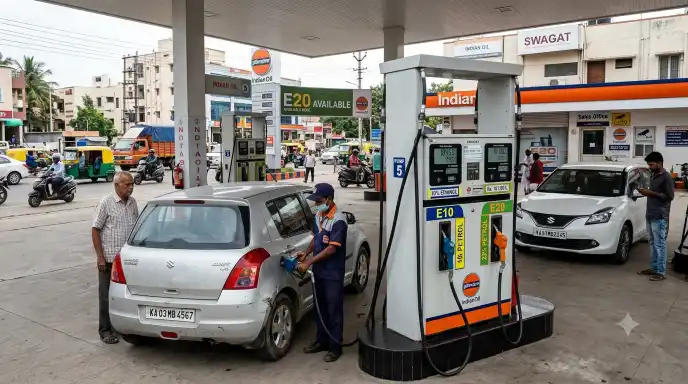
E10 petrol contains 10% ethanol and 90% petrol, while E20 contains 20% ethanol and 80% petrol.
Speaking at BPCL’s 73rd annual general meeting, Khanna said oil marketing companies do not expect major logistical problems in supplying E10. However, the arrangements needed to sell E10 and E20 at the same time are still being discussed.
Khanna said existing fuel infrastructure could be used if the industry moves towards supplying E10. However, operating two petrol grades simultaneously would create some supply and distribution challenges that are currently being examined.
One option under consideration is providing E10 petrol specifically for older vehicles. Khanna said discussions are ongoing on how such a system could work and how widely E10 could be made available.
Why E10 Is Being Considered
The discussions come amid concerns from consumers and opposition parties about the impact of E20 petrol on older vehicles. Concerns include lower mileage, compatibility of fuel-system components and responsibility for potential repair costs.
Chief Economic Adviser V Anantha Nageswaran recently suggested that the government consider making E10 petrol available alongside E20 at fuel stations to address concerns among owners of older vehicles.
However, the government has previously said there is no plan to return to E10 or E0 petrol.
Minister of State for Petroleum Suresh Gopi told the Rajya Sabha on August 10 that maintaining separate nationwide supply chains for E0, E10 and E20 petrol across more than one lakh retail outlets would increase logistical complexity, inventory requirements and handling costs.
The government has maintained that E20 has undergone extensive testing and has been accepted by the automobile industry, with the policy aimed at moving towards higher ethanol blending rather than returning to lower-blend fuels.
BPCL’s latest comments indicate that E10 is being considered as a possible fuel option for older vehicles, rather than as a replacement for E20.
E20 Petrol Rollout
The issue gained attention after the Centre directed oil marketing companies from April 1 to sell petrol containing up to 20% ethanol with a minimum Research Octane Number of 95.
The rollout of E20 has led to concerns among vehicle owners about fuel efficiency, vehicle compatibility and the possible impact on older vehicles.
The ongoing discussions could determine whether a separate E10 supply can be introduced for older vehicles while E20 remains the standard petrol blend for the wider market.
