


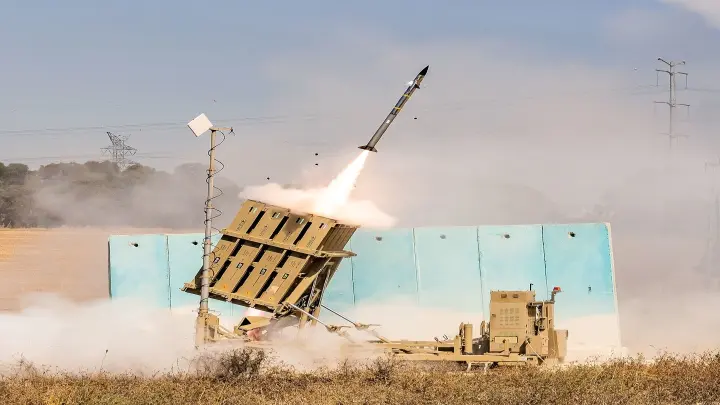
Israeli defence company Rafael Advanced Defence Systems is in discussions with several Indian private-sector defence manufacturers to establish production facilities for the Iron Dome air defence system and its Tamir interceptor missiles, according to industry sources.
The move is aimed at strengthening global supply chains, meeting rising export commitments, and helping replenish Israel’s own military stockpiles.
Rising global demand driving expansion plans
The initiative comes amid a sharp increase in global demand for Tamir interceptors, fuelled by ongoing conflicts in the Middle East and other regions. Israel and its partners are seeking to rapidly scale up production capacity to keep pace with battlefield requirements.
Officials familiar with the development said the India-based production setup would primarily support faster manufacturing and restocking during high-intensity military operations.
Role of the Tamir interceptor
The Tamir missile, which forms the core of the Iron Dome system, is designed to intercept short-range aerial threats such as rockets, drones, cruise missiles, and artillery fire within a range of 4 to 70 kilometres.
The system is known for its high effectiveness, with reported interception rates exceeding 90 percent, particularly in scenarios involving large-scale coordinated attacks.
However, the missile is technologically complex, requiring advanced guidance systems, electro-optic sensors, propulsion units, and precision fuze mechanisms, making large-scale production challenging even for experienced defence manufacturers.
Supply strain during prolonged conflicts
Recent military engagements have significantly strained Israel’s interceptor stockpiles. In sustained conflicts, adversaries have increasingly relied on mass rocket and drone attacks designed to overwhelm air defence systems and deplete missile inventories.
This has exposed a critical challenge: interceptor consumption in active warfare is far higher than current production capacity, creating logistical pressure on supply chains.
In past crises, the United States has supported Israel with emergency missile resupply packages. Rafael has also worked with American firm Raytheon to produce the SkyHunter, a US-built variant of the Tamir interceptor, to expand global output.
India emerges as key manufacturing partner
Against this backdrop, India is being seen as a strategic partner for expanding production. The country offers a growing defence manufacturing ecosystem, skilled engineering talent, and strong policy support through initiatives such as Make in India and Aatmanirbhar Bharat.
India’s private sector has also developed strong capabilities in areas such as aerospace components, precision engineering, and advanced electronics.
Existing collaboration builds confidence
Rafael already has an established presence in India through Kalyani Rafael Advanced Systems (KRAS), a joint venture based in Hyderabad. The facility has previously produced Medium Range Surface to Air Missile (MRSAM) systems for the Indian armed forces, demonstrating India’s capability in high-end defence manufacturing.
This existing partnership is seen as a foundation for deeper cooperation, potentially positioning Indian firms as key contributors to global production of the Iron Dome’s interceptor systems in the future.
