


Adani Vizhinjam International Seaport has achieved a major milestone by handling 2 million twenty-foot equivalent units (TEUs) within only 18 months of starting operations, making it the fastest Indian port ever to reach the mark.
Developed and operated by Adani Ports and Special Economic Zone Ltd. (APSEZ) for the Government of Kerala, the port began trial operations in July 2024 and was officially inaugurated by Prime Minister Narendra Modi in May 2025. It had already crossed the 1 million TEU milestone by August 2025, reflecting one of the fastest operational scale-ups seen in India’s maritime sector.
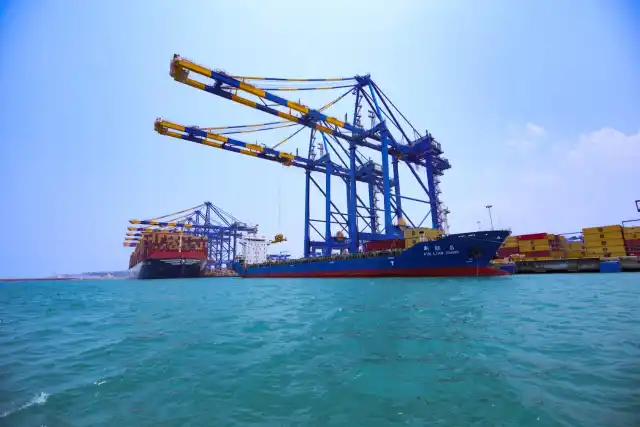
The achievement further strengthens Adani Vizhinjam’s position as a globally competitive deep-water transshipment hub and highlights growing confidence among international shipping lines in the port’s infrastructure, efficiency and strategic location.
As geopolitical tensions, supply-chain disruptions and instability in West Asia continue to reshape global shipping routes, Adani Vizhinjam is increasingly being viewed as a reliable and strategically located maritime gateway along the Indian Ocean corridor.
Since operations began, the port has serviced more than 950 vessels, including 67 Ultra Large Container Vessels measuring close to 400 metres in length. It has also welcomed some of the world’s largest container ships, including MSC Irina, currently recognised as the world’s biggest container vessel, and MSC Verona, one of the deepest-draft ships to berth at an Indian port.
Its capability to handle next-generation mega vessels places Adani Vizhinjam among a select group of international ports equipped for large-scale transshipment operations with high efficiency.
Located just 10 nautical miles from the international east-west shipping route, Vizhinjam enjoys a significant geographic advantage connecting South Asia, the Middle East, Europe and Africa. The port’s natural depth of around 20 metres allows large vessels to dock without extensive dredging, reducing turnaround time and improving operational efficiency.
The port now offers regular shipping connectivity across South Asia, Europe, Africa and South America, enabling faster cargo movement while strengthening India’s footprint in global maritime trade. Its proximity to major global shipping lanes also helps shipping operators reduce transit time and fuel costs, making Vizhinjam an increasingly attractive transshipment destination in the Indian Ocean Region.
The rapid increase in cargo volumes is expected to reduce India’s long-standing dependence on foreign transshipment hubs across Asia. For decades, a significant share of Indian cargo was routed through overseas ports. Adani Vizhinjam’s growth is now helping India retain more transshipment traffic domestically while improving its competitiveness against established global hubs.
The port’s expansion is also strategically important for India’s broader trade ambitions. As volumes continue to grow,Adani Vizhinjam is expected to strengthen maritime connectivity, improve cargo retention and enhance India’s role in global supply chains.
Its rise comes at a time when global shipping operators are increasingly prioritising resilient maritime infrastructure and diversified trade routes amid growing geopolitical uncertainty.
Meanwhile, Phase 2 expansion of the port is currently underway with an estimated investment of ₹16,000 crore and is expected to be completed by 2028. The expansion will significantly boost container handling capacity and pave the way for full-scale export-import operations.
Recently, APSEZ also became the first integrated transport operator in India to handle more than 500 million metric tonnes of cargo in a single year, further consolidating its leadership in the country’s private ports sector.
