


Union Minister Ashwini Vaishnaw said Indian Railways has utilised 98 per cent of its capital expenditure for the financial year 2025–26, reflecting rapid execution of infrastructure projects across the country. He added that in the coming years, trains are expected to outperform air travel on several key routes due to major improvements in speed and connectivity.
Speaking about recent progress, the minister noted that 49,000 kilometres of railway tracks have been electrified, exceeding Germany’s entire rail network, while 36,000 kilometres of new tracks have been added—an expansion roughly six times the size of Switzerland.
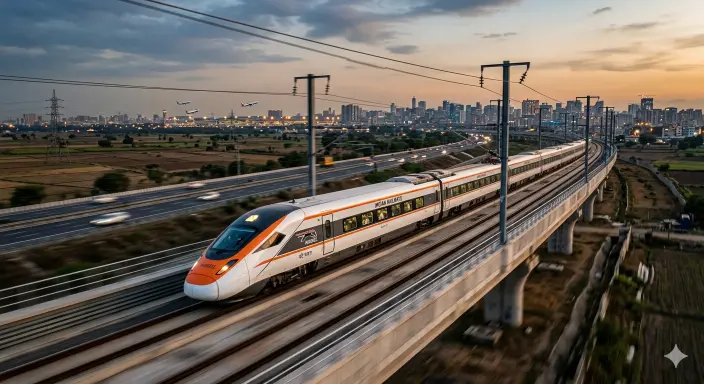
Vaishnaw highlighted that new high-speed corridors are being developed, which will significantly reduce travel time between major cities. Routes such as Mumbai–Pune, Pune–Hyderabad, Hyderabad–Bengaluru, Delhi–Varanasi, and Delhi–Lucknow are expected to see drastic reductions in journey duration, making train travel faster and more convenient than flights in some sectors.
He stated that on several routes, trains could become the dominant mode of transport. In some cases, air travel may no longer be viable due to extremely short rail travel times.
The minister also pointed to improvements in freight operations, especially coal transportation. He said power plants now hold record coal stocks, far above normal levels, ensuring stable energy supply across the country.
Vaishnaw further said the last financial year recorded the safest performance in the 150-year history of Indian Railways, with accidents reduced significantly. The Dedicated Freight Corridor has also been fully completed, improving freight movement efficiency and reducing transit time.
In addition, he announced that India has begun exporting advanced train propulsion systems to countries including Germany, Italy, Switzerland, Poland, and the United States, marking a major milestone in railway manufacturing capability.
Overall, he said Indian Railways is undergoing a transformation that will reshape passenger and freight transport in the coming years.
