


Members of the Indian Space Research Organisation (ISRO) recently visited Japan’s Tanegashima Space Centre as part of preparations for the upcoming Lunar Polar Exploration (LUPEX) mission, also known as Chandrayaan-5 in India.
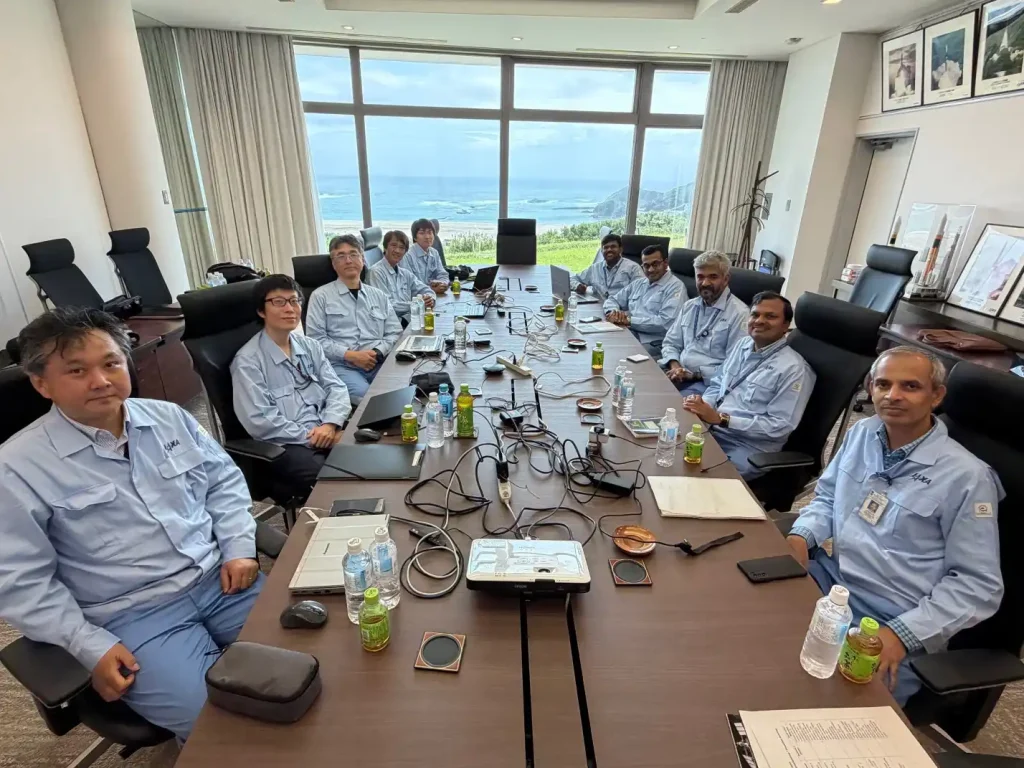
During the visit, the team inspected launch facilities, reviewed integration systems, and participated in technical discussions with the Japan Aerospace Exploration Agency (JAXA). These checks are part of ongoing preparations ahead of launch activities planned using Japan’s H3 rocket.
Strengthening Collaboration in Space Exploration
The mission is a joint effort between India and Japan, combining an Indian-built lander with a Japanese-built rover designed to explore the Moon’s South Pole. Photos from the visit showed engineers and scientists from both agencies working together during meetings and standing at the facility under the flags of both nations, reflecting deepening cooperation in space research.
Over the past year, both agencies have conducted multiple technical sessions to finalize design and mission readiness. India has progressed with lander engine tests, while Japan continues development of its advanced rover system.
Mission Focus on Lunar Water Ice
Chandrayaan-5 aims to study the Moon’s permanently shadowed regions near the South Pole, which are believed to contain water ice. Scientists hope to understand how much ice exists, its composition, and its potential usability for future space missions.
The lander will deliver the rover safely to the lunar surface. The Japanese rover, weighing around 350 kg, will then move across the terrain, drill up to five feet beneath the surface, and collect samples for analysis.
Instruments from NASA and the European Space Agency (ESA) will also contribute to data collection, making it a truly international scientific effort.
Towards Future Lunar Exploration
The mission is expected to last at least three and a half months, with the possibility of extending up to a year. It builds on the success of Chandrayaan-3, which achieved a historic soft landing near the Moon’s South Pole in 2023.
Experts believe that confirming usable water on the Moon could significantly change the future of space exploration, enabling astronauts to produce drinking water, oxygen, and even rocket fuel directly on the lunar surface.
Chandrayaan-5 represents a major step forward in India–Japan space cooperation, with launch expected no earlier than 2028 from Tanegashima.
