


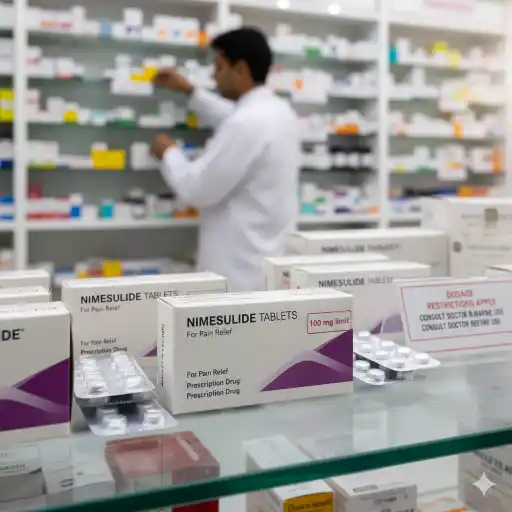
India’s health authorities have banned the manufacture, sale, and distribution of oral nimesulide formulations exceeding 100 mg for human use, marking a major regulatory step against the widely prescribed painkiller.
Government Decision and Health Rationale
The move comes after safety concerns raised by the Indian Council of Medical Research (ICMR), which highlighted the drug’s link to liver toxicity, potentially fatal in certain cases. In a notification issued on December 30, the government said prohibiting higher-dose formulations was necessary in the public interest.
Regulatory History and Expert Review
Nimesulide has previously faced multiple restrictions in India. Its use in children under 12 was banned following reports of severe liver damage, and veterinary use was prohibited in February 2025. ICMR later flagged safety concerns for adults as well, recommending that nimesulide be used only as a second-line treatment when safer alternatives fail.
While some experts advocated a nationwide ban, the Drug Technical Advisory Board recommended a detailed review covering adolescents, older adults, and children. The board acknowledged nimesulide’s effectiveness for short-term fever and pain relief but supported banning immediate-release oral formulations above 100 mg.
Global Context and Market Impact
Nimesulide, a non-steroidal anti-inflammatory drug, was first introduced in Italy in 1985 and entered the Indian market in 1995. Despite its widespread domestic use, major markets including the US, UK, Canada, Australia, and Japan never approved the drug due to safety concerns. In India, nimesulide currently accounts for an estimated ₹500 crore annual market turnover.
By restricting higher-dose oral formulations, the government has strengthened oversight of a commonly prescribed drug while stopping short of a full ban. The move balances clinical utility with patient safety and signals stricter scrutiny for medicines with unresolved risk profiles.
