


What if elephant and rhino dung could become notebooks, journals and other everyday stationery? An Assam-based venture is turning this unusual idea into a sustainable business, combining waste management, rural employment and wildlife conservation.
Founded by retired mining engineer Mahesh Chandra Bora and his daughter Nisha Bora, Elrhino Eco Industries Pvt Ltd converts elephant and rhinoceros dung into handmade paper and a range of eco-friendly products.
Established in 2014, the venture demonstrates how an unconventional raw material can create commercial value while supporting communities living close to wildlife habitats.
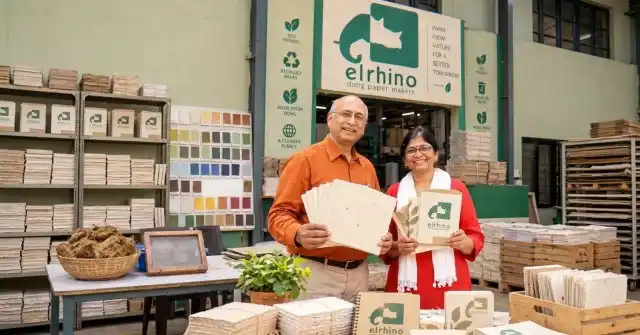
From an Unusual Idea to a Startup
The idea came to Mahesh Bora during a flight when he read about paper being manufactured from elephant dung in Rajasthan. He began exploring whether the same concept could work in Assam, a state known for its elephants and one-horned rhinoceroses.
After retiring, Mahesh started experimenting at home using everyday equipment, including a kitchen blender and window screens. Several trials later, he succeeded in producing handmade paper from the fibres found in animal dung.
His daughter Nisha, who had spent nearly 17 years in the corporate sector, joined him to develop the idea into a commercial venture. Her experience in market research and business development helped take the initiative forward.
Together, they established Elrhino in 2014.
How Elephant and Rhino Dung Becomes Paper
Elephants and rhinos consume large quantities of grass and vegetation. Their digestive systems do not completely break down these plant fibres, leaving fibrous material in their dung that can be used for papermaking.
Elrhino collects the dung and processes it through several stages.
- Cleaning: The collected dung is washed to remove impurities.
- Boiling: The material is boiled and prepared for processing.
- Pulping: The remaining fibres are converted into pulp.
- Mixing: The pulp is combined with recycled paper, cotton waste and other natural fibres.
- Sheet formation: The mixture is pressed into sheets and dried to produce handmade paper.
The finished paper has a distinctive texture and visible natural fibres.
Notebooks, Journals and More
Elrhino uses its handmade paper to manufacture a variety of products, including:
- Notebooks and journals
- Paper bags
- Playing cards
- Lampshades
- Decorative stationery
- Other handcrafted paper products
The venture also experiments with natural materials such as banana stems, pineapple bark, water hyacinth, jute and other forest resources to create different paper products and designs.
According to the company’s website, its manufacturing approach uses forest waste and alternative natural fibres to reduce dependence on virgin wood pulp.
Turning Wildlife Waste into Rural Livelihoods
Elrhino’s business model extends beyond sustainable paper production. It aims to create economic opportunities for communities living near forests and wildlife habitats in Assam.
The venture works with local villagers who collect elephant and rhino dung, along with other forest materials. These resources are purchased and used in the paper-making process, providing an additional source of income for rural households.
Local artisans are also involved in processing and craft production, creating opportunities to develop skills and participate in the handmade paper industry.
The idea is to build a stronger economic connection between local communities and wildlife conservation.
Elephants and rhinos sometimes enter agricultural areas, damaging crops and creating challenges for farmers. By giving economic value to materials collected from wildlife habitats, Elrhino aims to encourage communities to recognise the value of protecting these animals and their natural environment.
A Business Model Connecting Sustainability and Conservation
Elrhino represents an approach to entrepreneurship that connects environmental responsibility with local economic development.
By converting wildlife waste into commercially useful products, the Assam-based venture offers an alternative to conventional wood-pulp paper while creating opportunities for rural communities.
Its model also highlights how startups can explore unconventional raw materials and build businesses around sustainability, local resources and conservation.
From an experiment in a kitchen to a handmade paper enterprise, Mahesh and Nisha Bora’s journey shows how an unusual idea can create value for both people and the environment.
