


India’s Mumbai-Ahmedabad bullet train project has witnessed a sharp increase in its estimated cost, with the latest figure reaching ₹2,02,797 crore, nearly double the original estimate of ₹1.08 lakh crore. The 508-km high-speed rail corridor, India’s first bullet train project, has also faced significant delays since its launch.
According to an RTI response obtained by Deccan Herald, the National High Speed Rail Corporation Limited (NHSRCL) had spent ₹92,761 crore on the project as of March 2026. The revised cost estimate reflects the financial impact of prolonged construction, land acquisition challenges and changes in the project’s technical and procurement plans.
The corridor connects Mumbai and Ahmedabad through Maharashtra, Gujarat and the Union Territory of Dadra and Nagar Haveli. It was initially targeted for completion in 2022, but the timeline has shifted. The first section is now expected to become operational in December 2027, according to reports. NHSRCL has said that the overall completion timeline can be determined after all contract packages are awarded.
Why has the bullet train project become more expensive?
Several factors have contributed to the increase in the project’s estimated cost. The Ministry of Railways has cited detailed engineering requirements, exchange-rate fluctuations, land acquisition, rehabilitation and resettlement expenses, inflation and costs that were not included in the initial feasibility report.
The shift in construction design also influenced the overall expenditure. While the original plan envisaged a combination of elevated sections and embankments, the decision was taken in 2016 to build the corridor entirely on viaducts. This was intended to reduce land acquisition requirements, avoid dividing villages, improve safety and minimise drainage-related issues.
Additional expenses include taxes and cess, utility shifting, power sourcing, station approach development, statutory charges and ticketing infrastructure.
A report by the Standing Committee on Railways for 2026-27 also identified major cost components, including ₹29,330 crore towards taxes and cess, ₹19,084 crore due to inflation and price increases, ₹16,695 crore for land acquisition and rehabilitation, and ₹16,500 crore for indigenous rolling stock and the ETCS signalling system.
Technology and train procurement plans change
The project has also undergone changes in its original technology and procurement strategy. Initially, the corridor was planned to operate with Japan’s Shinkansen trainsets and technology. However, delays in finalising train procurement and differences over technology transfer and project execution led India to pursue a more domestic approach.
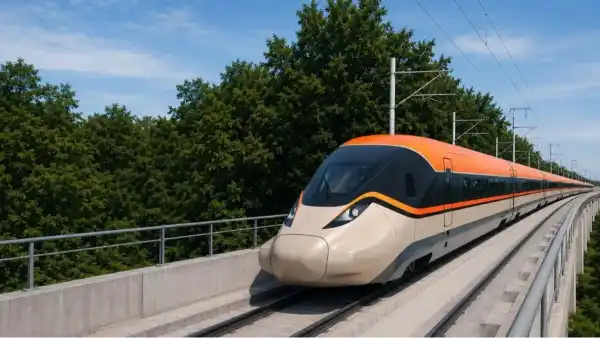
The current plan is to begin operations with indigenously developed trainsets manufactured by BEML. The first trainset is scheduled for dispatch in February 2027, according to the NHSRCL response cited in the RTI report.
The project is also adopting European-standard signalling technology alongside Japanese track technology. The combination represents a shift from the original plan of using an integrated Japanese high-speed rail system.
Completion timeline remains a key concern
The Mumbai-Ahmedabad corridor spans 508 km and is designed for trains operating at speeds of up to 320 kmph. It includes 12 stations, connecting major locations such as Mumbai, Thane, Virar, Boisar, Vapi, Surat, Bharuch, Vadodara, Anand, Ahmedabad and Sabarmati.
The project has faced delays linked to land acquisition, particularly in Maharashtra, statutory clearances, construction challenges and train procurement. The Covid-19 pandemic and changes in the Maharashtra government also affected execution.
While the first section is expected to open in December 2027, the final completion schedule for the entire corridor remains uncertain. NHSRCL has indicated that a comprehensive timeline will be available after all contract packages are awarded.
The increase in cost and the extended timeline have brought the project’s financial and operational viability into focus. At the same time, the government expects the corridor to help develop domestic capabilities in high-speed rail technology, engineering, train manufacturing and infrastructure development.
