


India’s naval aviation capabilities have reached a major milestone with the Rafale Marine fighter jet successfully making its maiden landing on the country’s indigenous aircraft carrier, INS Vikrant. The aircraft completed the landing on its first attempt on October 29, 2026, marking an important step towards its operationalisation in the Indian Navy.
The Navy announced the achievement on October 30 and shared video footage of the landing. The ongoing trials are intended to assess the aircraft’s compatibility with India’s aircraft carriers and prepare it for operational service.
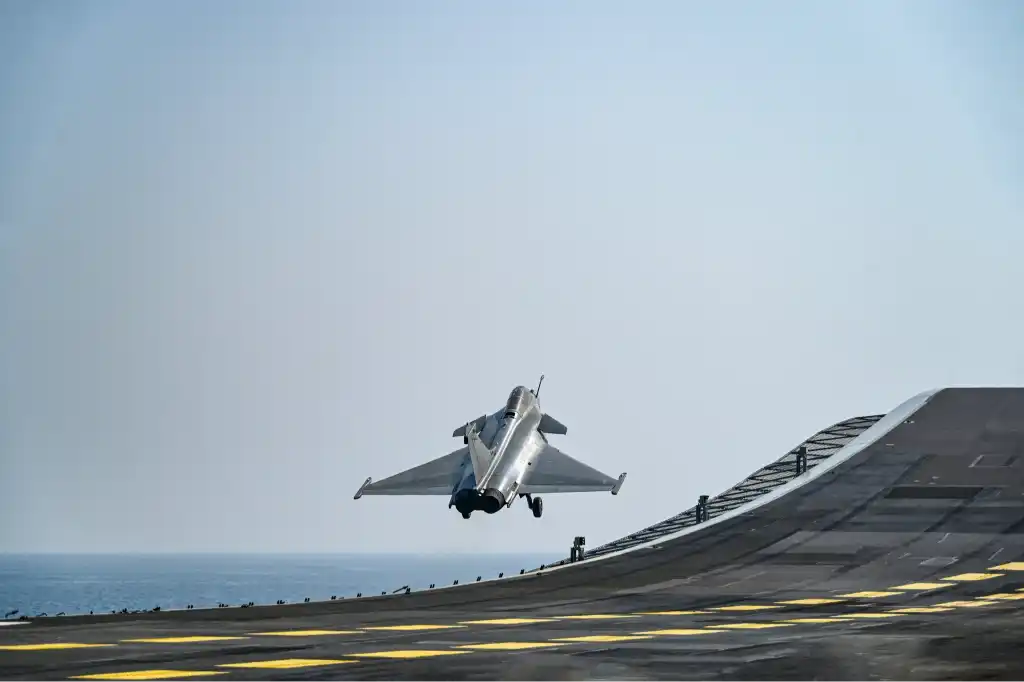
Rafale Marine Tested for Carrier Operations
The landing is part of trials to validate the French-origin fighter jet for operations from INS Vikrant. India’s aircraft carriers use the Short Take-Off But Arrested Recovery (STOBAR) system. Under this configuration, aircraft take off using a ski-jump ramp and land with the help of arrestor wires on the flight deck.
This differs from the Catapult Assisted Take-Off But Arrested Recovery (CATOBAR) system used by France’s aircraft carrier Charles de Gaulle, for which the Rafale Marine was originally designed.
Before the carrier landing, the Navy conducted shore-based trials at the Shore-Based Test Facility at INS Hansa in Goa. The facility replicates the ski-jump and arrestor-wire arrangements of an aircraft carrier, allowing the Navy to assess the modifications and operational requirements.
India-France Deal for 26 Rafale Marine Jets
India signed an inter-governmental agreement with France on April 28, 2025, to procure 26 Rafale Marine fighter aircraft for the Navy. Valued at approximately ₹63,000 crore, the deal includes 22 single-seat fighters and four twin-seat trainers.
The package also covers weapons, simulators, training, equipment and logistical support. It includes technology transfer for integrating indigenous weapons and provisions for manufacturing Rafale fuselage components in India, along with maintenance facilities.
Deliveries are expected to begin in 2028. The aircraft will operate from both INS Vikrant and INS Vikramaditya and are expected to strengthen India’s maritime air defence, reconnaissance and strike capabilities.
The Rafale Marine fleet will eventually help replace the Navy’s Russian-origin MiG-29K fighters. The successful landing is an early milestone, with further trials and integration work required before the aircraft enters operational service.
