


India’s effort to develop an “artificial Sun” for nuclear fusion research has moved forward with the installation and commissioning of a new 82.6 GHz, 400 kW gyrotron on the SST-1 tokamak at the Institute for Plasma Research in Gujarat.
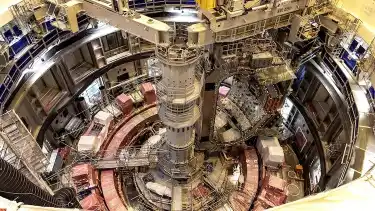
The SST-1, or Steady State Superconducting Tokamak, is an experimental fusion machine designed to recreate the conditions needed for nuclear fusion. Fusion is the process that powers the Sun and other stars, where light atomic nuclei combine and release large amounts of energy.
The new gyrotron is designed to provide high-power microwave heating to the plasma inside the tokamak. Maintaining extremely hot plasma and keeping it confined for long periods are among the major challenges in developing practical fusion energy.
India’s fusion programme is part of a wider global effort to develop fusion as a potential source of low-carbon and abundant energy. Research facilities around the world are working on different approaches to achieving sustained fusion reactions and eventually producing useful electricity.
The upgraded SST-1 adds to India’s capabilities in high-temperature plasma research and fusion technology. However, commercial fusion power remains a major scientific and engineering challenge globally, and the technology is still under development.
