


Kerala has registered 79,905 Waqf properties on the Union government’s UMEED portal, becoming one of the top-performing states in India in digitising Waqf asset records. The state accounts for nearly 10% of the total 7.99 lakh Waqf properties uploaded across the country and leads among southern states.
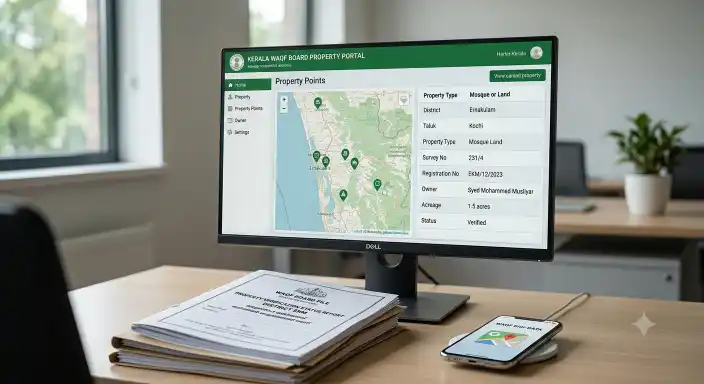
According to data shared by Union Minority Affairs Minister Kiren Rijiju in a written reply to the Rajya Sabha, Kerala ranks third nationally in the number of Waqf properties registered on the portal. It is behind the Uttar Pradesh Sunni Waqf Board, which has uploaded 1.53 lakh properties, and West Bengal with 1.32 lakh properties.
Kerala has surpassed several states with higher populations, including Telangana with 63,984 properties, Karnataka with 58,845, Gujarat with 30,783, Rajasthan with 32,335, and Madhya Pradesh with 32,374 properties.
Out of the 79,905 properties submitted by the Kerala Waqf Board, 63,086 have received approval from designated authorities. Around 7,979 properties are under scrutiny, 17 are awaiting final approval, and 3,902 remain at the data-entry stage. Another 4,921 entries have been rejected or returned for corrections.
The Union government launched the UMEED portal in June 2025 to create a central digital database of Waqf properties across India. The platform aims to improve transparency, strengthen record management, and help prevent disputes and illegal occupation of Waqf assets.
State Waqf Boards were initially given six months to complete the uploading process, but several states sought additional time through Waqf Tribunals and High Courts. Kerala received a five-month extension in December 2025 and another one-month extension in May 2026 to complete the registration and verification process.
Nationwide, 7,99,027 Waqf properties have been uploaded on the portal. Of these, 6,17,192 properties have been verified and approved, while 91,275 are still under different stages of review. Around 90,560 entries have been rejected during the verification process.
The digitisation drive is expected to help address challenges related to Waqf property management, especially cases involving encroachments. According to another Rajya Sabha reply by Kiren Rijiju, 53,930 Waqf properties across the country have been identified on the UMEED portal as being under encroachment by private individuals or government agencies.
The minister stated that the exact number of encroached properties, revenue generated from Waqf assets, and progress of eviction proceedings can be determined only after the completion of the digitisation and verification process. Under the Unified Waqf Management, Empowerment, Efficiency and Development Act, the State Waqf Board’s chief executive officer can initiate proceedings before the Waqf Tribunal for removal of encroachments after an inquiry.
